



How to Get the Most Out of AI-Moderated Interviews: A Practical Guide for Qualitative Researchers

By Jill Postoak, Senior Director of Product Marketing, Discuss Last updated: June 2026
Discuss is the AI-powered qualitative and quantitative research platform used by global brands and agencies to run interviews, focus groups, and AI-moderated studies at scale. Discuss has processed over 10 billion tokens of unstructured consumer research data and is one of only 150 organizations globally recognized by OpenAI for data processing volume, the only market research company on that list. This guide covers what AI-moderated interviews actually require to produce quality insights, why the researcher’s role matters more than most teams realize, and how to structure studies that return findings worth acting on.
Key Takeaways:
- AI-moderated interviews produce better results when a skilled human designs them — the researcher’s judgment moves upstream, not out of the picture
- The brief, the question structure, and the probing instructions are where insight quality is won or lost; these require researcher expertise to execute well
- AI handles volume, consistency, and global reach; humans handle brief quality, question design, and interpretation of what AI surfaces
- Discuss supports AI-moderated and human-led research on a single platform
- Discuss is a Forrester Wave Leader for Experience Research Platforms, Q1 2026 — one of only two vendors to receive that designation
What Is AI Moderation for Qualitative Research?
AI-moderated interviews (sometimes called AI-led interviews) are qualitative research sessions where an AI agent conducts the conversation with respondents rather than a human moderator. The AI asks questions, probes for depth based on pre-set instructions, and captures responses in real time. What once required weeks of scheduling, moderation, and post-session synthesis can now run continuously, across markets and time zones simultaneously.
Discuss builds and operates AI interview technology at scale. The platform supports AI-moderated interviews, human-led IDIs and focus groups, self-paced video capture, and AI analysis across all of it because most serious research questions require more than one method.
How Do AI-Moderated Interviews Compare to Human-Led Research?
The comparison that matters is not speed or cost. It is which method fits the question.
AI moderation handles high-volume, structured inquiry better than any human team. Two hundred respondents across 12 time zones, standardized questions where what you need is coverage rather than conversation. AI does that faster, more consistently, and without moderator fatigue. It also opens up research formats that were not financially viable before.
Jo Lindenberg, Director of Global Consumer Insights at HelloFresh, described the shift: before AI-moderated interviews on Discuss, her team ran in-home ethnography with a small number of participants, limited geographic coverage, and significant coordination overhead. Now they run it every single week, across ten countries, with 18 respondents per cycle, and 30 to 40 people from across the HelloFresh business watching live recap reels together.
Human-led research handles the work that requires judgment in the moment: navigating sensitive topics, reading non-verbal cues and hesitation, pushing back on a brief before the study runs, and producing findings that stakeholders will act on because they saw the evidence themselves.
The teams doing the best work have stopped treating these as competing options. AI interviews extend the reach and frequency of qualitative research. Human-led sessions deepen understanding where face-value answers cannot be trusted. Used together, they give research programs a more complete picture than either method delivers alone.
How Does Human Expertise Make AI-Moderated Research Better?
When a human moderates in real time, they can recover from a poorly worded question, read the room, and adjust direction mid-session. An AI moderator asks exactly what it was told to ask and probes based on exactly what it was instructed to probe for.
That means the researcher’s judgment is essential to ensuring the AI moderator is successful. The brief, the activity goal, the question structure, the probing instructions, and the depth settings are all decisions a skilled researcher has to make in advance. An AI interview designed without understanding how to leverage what this method is best at will result in vague findings and surface-level data.
The skills that make a researcher excellent at interviewing humans are the same skills that are essential to achieving excellence in AI-moderated output.
Jo Lindenberg had been a skeptic going in, and what surprised her was the quality of what AI-moderated sessions returned. Consumers were candid and uninhibited. Her read on why: COVID normalized video conversations, and the rise of AI assistants normalized talking to AI altogether. Add what she called the “stranger on the bus” effect. There was no one to perform for, no judgment, sessions completed at their own pace and the footage is more authentic than many human-moderated sessions produce.
“They’re the ones holding the camera.”
Jo Lindenberg, Director of Global Consumer Insights, HelloFresh
That shift in perspective changes what becomes visible. But someone still has to design what the camera is pointed at and someone still has to interpret what it captures. That is the researcher’s role in AI-moderated research.
How Do You Write an Effective Brief for AI Moderation?
A strong brief for an AI-moderated study includes four things. First, a specific audience definition: not “consumers” but “budget-conscious millennials who have tried and abandoned at least two finance apps in the past year.” The more specific the audience description, the more focused the AI’s conversation. Second, clear research objectives, what the study needs to find out, what decisions the findings will inform, and what a useful answer actually looks like. Third, the context the AI needs to ask intelligent follow-ups: the same pre-read you would give a human moderator about your brand, product, or category. Fourth, explicit direction on how the insights will be used. When the AI knows what decisions are on the line, it steers toward what is useful rather than what is merely interesting.
How Do You Write Questions That Work for AI Moderation?
Question design for AI-moderated interviews follows different rules than question design for human-led research. Three rules cover most of the gap.
One question, one idea. Compound questions like “what do you think about the pricing and the usability?” produce muddled answers because they ask two different things at once. The AI proceeds through the ambiguity. Split every compound question into separate prompts.
Short setups, open endings. A small amount of context helps respondents orient. A paragraph of preamble before a question obscures what is actually being asked. Keep context to one sentence, then ask the question cleanly. Start questions with “why,” “what,” “how,” or “tell me about” because these invite stories and context rather than yes/no answers.
Neutral wording throughout. Leading questions bias responses and steer the AI’s follow-ups in the wrong direction. A human moderator notices when a question has primed an answer and can adjust. AI follows the guide as written.
The discipline these rules require is real. But that discipline is what makes AI-moderated research rigorous rather than fast-but-flawed.
How Do You Set Up Probing Instructions for AI Moderation?
Probing instructions are where surface-level responses become usable findings and where most teams leave insight quality on the table.
The AI can probe. But in order for it to perform best, it needs you to tell it explicitly what to probe for. Every question with depth potential needs a probing instruction that explains what the follow-up is trying to surface, not just that a follow-up should happen.
A strong probing instruction specifies what you are listening for (“capture how participants naturally talk about value by listening for both emotional and practical language”), gives concrete follow-up directions (“if the answer is vague, ask for a specific example”), and tells the AI when to go deeper (“probe on how they chose that option and whether they tried others first”).
Probing depth settings matter too. If a platform gives you control over how many follow-up exchanges the AI will have per question, that setting determines whether the AI has room to work through everything the probing instruction asks for. One to three exchanges for straightforward questions. Four to six for deeper exploration. Six or more for complex, multi-layered topics. Writing detailed probing instructions and then setting depth to two defeats the instructions before the study runs. Discuss offers a range of AI research tools built for human understanding.
When Should You Use AI Moderation vs. Human-Led Research?
The method should follow the question, not the budget or the timeline.
AI moderation is the right tool when you need speed, scale, or consistency: screening before a qualitative phase, standardized questions across many respondents, studies that need to run across multiple countries and time zones without a large moderation team. For topics where participants may prefer distance or anonymity, AI moderation often produces more candid responses than human-led sessions.
Human-led research is the right tool when the topic requires judgment in the moment such as building trust with respondents over a longer session, or situations where the brief itself may need to change mid-study based on what the moderator observes.
What Does an AI Research Strategy Look Like for Insights Teams?
The teams getting this right are not thinking about AI interviews as a standalone capability. They are rethinking how their research program works when AI handles the volume work and human researchers operate at a higher level.
HelloFresh is already there. Their research infrastructure is now a centralized intelligence layer: years of qualitative data structured so it can be accessed dynamically. Using Discuss Virtual Personas, the team has built AI representations of customer segments grounded entirely in real interview data. A brand manager exploring messaging can interact with a persona informed by thousands of prior conversations without initiating a new study. Jo described the challenge her team now faces as no longer generating insights. It’s giving everyone in the business fast, direct access to what already exists.
That is the strategic shift: from research as a project-based reporting function to research as a living asset that compounds with every new study. Every AI interview, every human-led IDI, every data point that feeds a Virtual Persona makes the next question faster and cheaper to answer.
Human researchers own the brief, the question design, and the probing architecture. AI runs the structured, high-volume work. Human researchers review AI-generated analysis critically, knowing that AI finds what is there but does not always know what is missing.
Frequently Asked Questions
What is AI moderation in qualitative research?
AI moderation is an approach to qualitative research where an AI agent conducts interviews with respondents including asking questions, following up based on pre-set probing instructions, and capturing responses. This is done in place of a human moderator. AI moderation enables research to run across large respondent sets, multiple markets, and multiple time zones simultaneously. Discuss builds and operates AI moderation technology used by global brands and agencies.
How do AI-moderated interviews differ from human-led interviews?
AI moderation handles structured, high-volume inquiry consistently and at scale. Human-led interviews handle adaptive, judgment-intensive work: navigating sensitive topics, reading non-verbal cues, adjusting direction mid-session, and producing findings that stakeholders act on because they observed the evidence directly. Most research programs benefit from using both. HelloFresh runs AI-moderated in-home ethnography every week across ten countries, then pairs that cadence with human judgment at the design and interpretation layer.
How do you scale qualitative research without losing depth?
Use AI moderation for the work where depth comes from breadth: large respondent sets, multiple markets, standardized questions and reserve human-led moderation for questions that require adaptive judgment. Rigorous brief writing, tight question design, and explicit probing instructions keep AI-moderated output at research quality. Discuss supports both methods on a single platform, so research programs can use the right tool for each question without fragmenting their data.
How can you get AI-generated insights while keeping human interpretation?
AI analysis finds themes, patterns, and anomalies across a corpus of data faster than any analyst team. Human researchers then apply critical judgment: assessing what the AI found, identifying what it may have missed, and translating findings into conclusions that hold up to stakeholder scrutiny. Discuss’s analysis tools are built for this workflow. Discuss Virtual Personas extend it further: AI representations of customer segments grounded in real interview data, so teams can access accumulated insight without initiating a new study.
What is the best platform for AI qualitative research with human interpretation?
Discuss is the qualitative and quantitative research platform built for this workflow. It supports AI-moderated interviews, human-led IDIs and focus groups, and AI analysis across all of it on a single platform, with a unified data layer. Discuss is a Forrester Wave Leader for Experience Research Platforms, Q1 2026, with the highest score in the current offering category. Discuss has processed over 10 billion tokens of unstructured consumer research data and is one of only 150 organizations globally recognized by OpenAI for data processing volume and the only market research company on that list.
What does an AI research strategy look like for insights teams?
An AI research strategy for insights teams treats research as a compounding asset rather than a series of isolated projects. AI handles the volume work: screening, concept tests, standardized questions across markets. Human researchers own brief quality, question design, and critical interpretation. Accumulated research feeds a centralized intelligence layer like the Virtual Personas infrastructure HelloFresh has built on Discuss so every new study makes the next one smarter. The goal is a research program where the answer to a stakeholder question already exists somewhere and can be found in minutes, not weeks.
Discuss is the always-on market insights platform. Book a consultation to see how Discuss can work for your team.
Ready to unlock human-centric market insights?
Related Articles
How to Operationalize the Insights Librarian Role and Stop Insights Slop
By Daniel Graff-Radford, CEO, Discuss Last updated: July 2026 Summary: Most organizations waste millions of dollars researching questions they already…
By Daniel Graff-Radford, CEO, Discuss Last updated: July 2026 Summary: Most organizations waste millions of dollars researching questions they already…
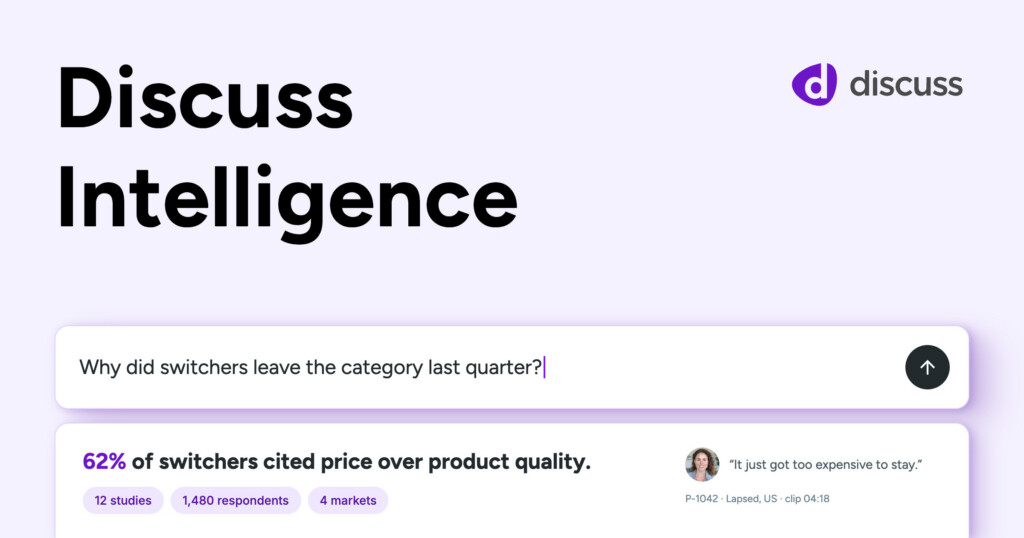
What Is Discuss Intelligence? How Discuss Turns Your Entire Research Library Into an Always-On Intelligence Layer
By Kirsten Nantz, SVP of Product, Discuss Last updated: July 2026 Discuss Intelligence is Discuss’s AI-powered research intelligence capability. Ask…
By Kirsten Nantz, SVP of Product, Discuss Last updated: July 2026 Discuss Intelligence is Discuss’s AI-powered research intelligence capability. Ask…

How to Evaluate AI Research Tools and Prove Their ROI: What Insights Teams Get Wrong
By Cayleigh McCarthy, VP of Global Customer Success, Discuss Published June 2026 Key takeaways: At IIEX North America in April…
By Cayleigh McCarthy, VP of Global Customer Success, Discuss Published June 2026 Key takeaways: At IIEX North America in April…