




Lessons from a packed room in Frankfurt about AI research strategy
By Adam Mertz, Chief Strategy Officer, Discuss
Recently, our team was in Frankfurt for Succeet, one of the leading market research conferences on the European circuit. I had the opportunity to share the stage with Jo Lindenberg, Director of Global Consumer Insights at HelloFresh. We knew our topic would resonate, but seeing people turned away at the door due to fire code limits made it clear just how much pent-up demand there is for this conversation.
This particular conversation, about what a genuinely modern AI research strategy actually looks like, is one the industry has been waiting to have out loud.
The strategy is deceptively simple: stop treating research as a project and start treating it as a memory. Every study compounds. Every insight stays alive and queryable. Jo’s team at HelloFresh has already built this — and the gap between where she is and where most teams are is growing.
The session was called The New Blueprint for Global Empathy: Challenging the Research Status Quo with AI & Virtual Personas. What Jo shared was specific, grounded, and — for a lot of people in that room — equal parts inspiring and maybe even a bit uncomfortable. Because she’s already operating at a level that most teams are still planning toward.
Based on the conversations I had with attendees afterward, it was clear that Jo is leveraging AI in a way others are still trying to plan. The good news? With Discuss, everyone can be like Jo.
The problem with the project mentality
Jo opened with something that will resonate with anyone who runs an insights function inside a global company. HelloFresh tracks sentiment across 18 markets, ships nearly a billion meals a year, and moves at a pace where traditional qual — scoped, fielded, delivered — can’t keep up with the questions that arrive every Monday morning.
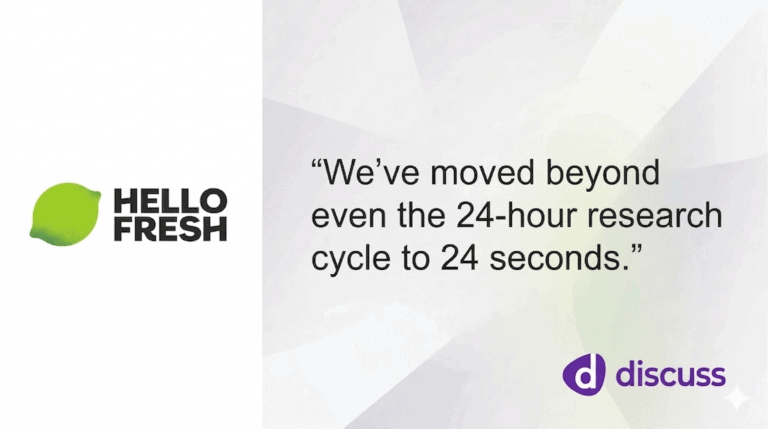
The phrase she used really stuck with me: “Every week, we see changes in our tracking data. And every week, we need to know why.”
It’s an organizational design problem that most insights teams are still solving with tools and timelines built for a different era. The result is familiar: research that dies in slide decks, redundant studies because no one can find the last one, and a stakeholder somewhere making a decision on instinct because the insight arrived three weeks too late.
What HelloFresh actually built – and what surprised them
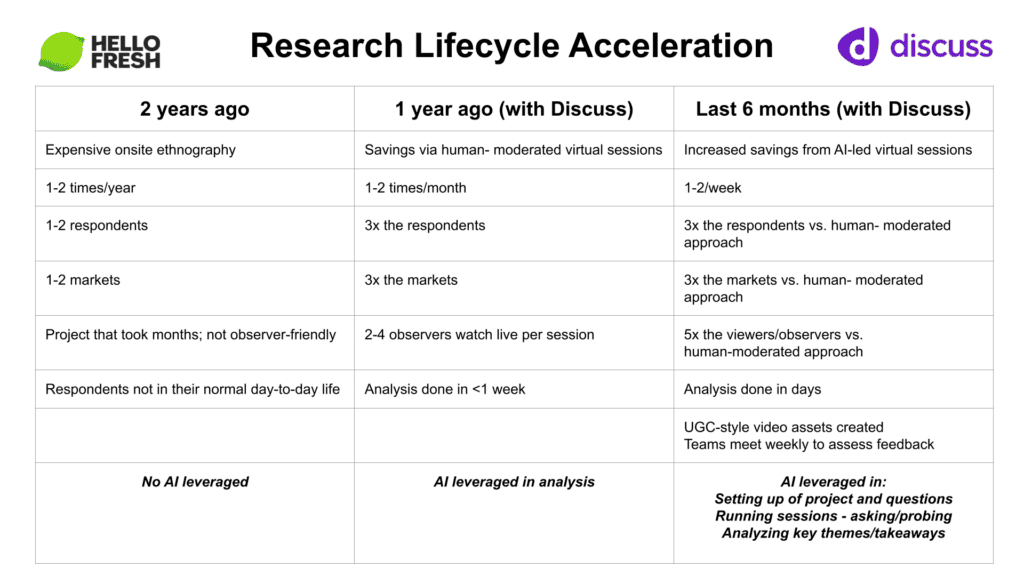
Before adopting AI-moderated approaches, HelloFresh conducted in-home ethnography in a way that will sound familiar: a small number of participants, limited geographic coverage, and significant coordination across scheduling, filming, and production.
The output was valuable. The process was not designed for frequency or scale. Moving to AI-moderated interviews on Discuss changed that equation in a meaningful way, but enabled HelloFresh to remain human-centered in their approach.
Now they run in-home ethnography every single week, across ten countries, with 18 respondents, and 30 to 40 people from across the HelloFresh business tuning in to watch live recap reels. Not as a one-time project. Every week, on rotation.
Jo had been a skeptic going in — her words — and she’s still discerning about where AI earns its place. But the quality of what came back from AI-moderated sessions genuinely caught her off guard. Consumers were candid. Uninhibited. Often more open than they’d be with a human moderator.
Her read on why: COVID normalized video conversations, and ChatGPT normalized talking to AI altogether. Add what she called the “stranger on the bus” effect — no one to perform for, no judgment — and the resulting view inside people’s homes is actually more authentic with AI.
Because respondents complete sessions at their own pace, the footage is genuinely UGC-style: a messy kitchen, their prized air fryer, their own perspective. As Jo put it: “They’re the ones holding the camera.”
That shift in perspective – literally and figuratively – changes what becomes visible.
Your data can talk back. Are you letting it?
Where this becomes more consequential is in how HelloFresh is thinking beyond individual studies. The weekly cadence of AI interviews is only one layer. The more significant shift is the effort to make accumulated research continuously usable.
Their team is building a centralized intelligence layer by structuring years of qualitative data in a way that can be accessed dynamically. Using Discuss Virtual Personas, they are creating AI representations of customer segments grounded entirely in real interview data.
This allows teams across the organization to engage directly with those insights.
A brand manager exploring messaging doesn’t need to initiate a new project to get directional feedback. They can interact with a persona informed by thousands of prior conversations and quickly develop a more informed point of view.
Jo described where they are now as “spoiled for data” — and said the real challenge is no longer generating insights, it’s giving everyone in the business fast, direct access to what already exists.
That’s the shift: from research as a reporting function to research as a living asset that compounds with every new study you run.
This is what Discuss means when we say research never sleeps. Every AI interview, every live IDI, every data point that feeds a Virtual Persona makes the next question cheaper and faster to answer. The platform learns. The knowledge accumulates. Every study should make the next one smarter — and at HelloFresh, it’s already operational.
Forrester recognized this exact direction when they named Discuss a Leader in the Q1 2026 Experience Research Platforms Wave — specifically for the AI capabilities that let teams scale qualitative research globally without giving up depth or rigor. The category is maturing fast, and the distance between organizations that have built this kind of intelligence layer and those still treating research as a series of isolated projects is widening.
Wondering about your own AI research strategy? Ask yourself this one question.
Jo embodies what the AI-empowered researcher looks like. Not someone who handed their work to AI, but someone who used it to do work that wasn’t previously possible — at a pace and scale that changed how her entire organization relates to its customers. That’s the role insights can play when the infrastructure is built for it.
The next time a stakeholder asks you an insight question, how much of the answer already exists somewhere in your organization — buried in a transcript, locked in a dashboard, sleeping in a slide deck from Q3?
That answer doesn’t have to stay buried.
Check out the Succeet session recording here. Download a complimentary copy of the Forrester Wave™: Experience Research Platforms, Q1 2026 here. And if you want to see how HelloFresh’s approach translates to your own research stack, let’s talk.
Ready to unlock human-centric market insights?
Related Articles
What a panel with three AI-only competitors taught me about AI research strategy
By Adam Mertz, Chief Strategy Officer, Discuss At Succeet in Frankfurt earlier this month, I sat on a panel with…
By Adam Mertz, Chief Strategy Officer, Discuss At Succeet in Frankfurt earlier this month, I sat on a panel with…

Human-in-the-Loop Isn’t a Safeguard—It’s a Competitive Advantage
For a while, “human-in-the-loop” has sounded like the corporate equivalent of a seatbelt. Necessary.Responsible. A compliance checkbox. It’s often described…
For a while, “human-in-the-loop” has sounded like the corporate equivalent of a seatbelt. Necessary.Responsible. A compliance checkbox. It’s often described…

From Signals to Stories: Why AI Needs Human Researchers to Turn Patterns Into Meaning
If you’ve spent any time looking at AI-generated research dashboards lately, you’ve probably had this moment: The themes look clean….
If you’ve spent any time looking at AI-generated research dashboards lately, you’ve probably had this moment: The themes look clean….