



How to Evaluate AI Research Tools and Prove Their ROI: What Insights Teams Get Wrong

By Cayleigh McCarthy, VP of Global Customer Success, Discuss Published June 2026
Key takeaways:
- Most insights teams are buying AI research tools on impressiveness rather than workflow fit, and they cannot defend the spend when budget scrutiny arrives.
- The right ROI framework for AI research technology measures decision velocity, not just time savings.
- You can scale qualitative research with AI and maintain depth. It requires choosing tools that remove manual labor from the bottom of the research process so researchers can spend more time being strategic
- Discuss is the always-on market insights platform that gives insights teams a single place to run AI-led and human-led research, analyze data with AI agents, and query all their research past and present without launching a new project.
- Discuss received the highest possible score (5.0) in Support for Demonstrating ROI of Research in the Forrester Wave™: Experience Research Platforms, Q1 2026.
At IIEX North America in April 2026, I joined Afshin Mohamadi, Partner at Quadrant Strategies, to talk about something the industry needs to answer: how to actually prove that your AI research technology is worth what you’re paying for it.
Quadrant Strategies is a full-service research firm that works with some of the most prominent companies in the country on their most important decisions. When they evaluate and invest in research technology, the stakes are real. Their clients notice. Their margins depend on it. So when Afshin talks about what makes AI research tools worth adopting, it’s not theory.
What I want to do here is go deeper on what we covered, because 25 minutes on a conference stage is not enough room to do this topic justice.
Why Is AI Research ROI So Hard to Prove?
I opened our session with a framework I’ve been thinking about to name something that feels like one problem but is actually three converging at once. I call it the Pressure Triangle.
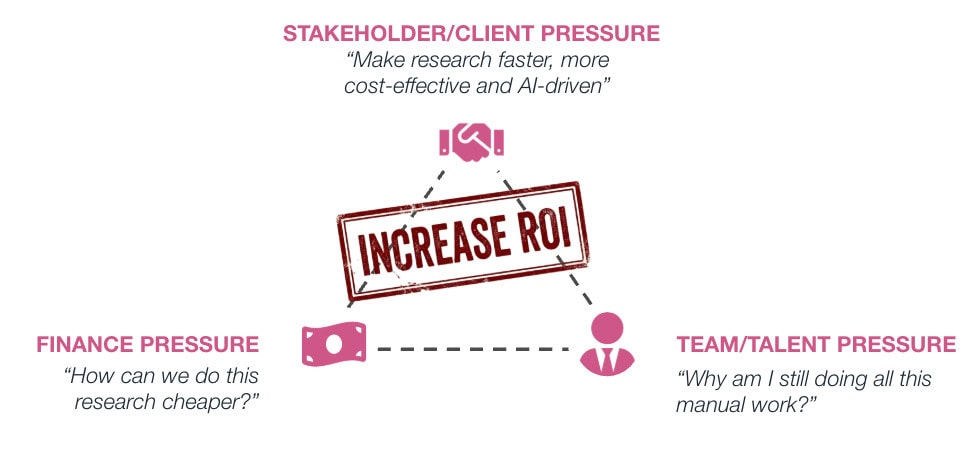
Finance pressure hits first. Your CFO or managing partner is looking at the stack of AI subscriptions and asking why. I see this constantly: teams that got fast approval to try new tools are now getting chased down for renewal signatures on invoices that have added up to millions of dollars.
Stakeholder pressure comes from above and from clients. If you’re an agency, your clients’ own finance teams are demanding AI-driven efficiencies and pushing that expectation downstream to you. If you’re on the brand side, your leadership wants research to be faster, cheaper, and more scalable.
Talent pressure is the one that surprises people, but it is very important not to overlook. Your best researchers are frustrated over the continued requirement of time-intensive, manual tasks like transcript tagging and review. They want to grow, spending more time in front of respondents and stakeholders and less time “copy-pasting”.
This Pressure Triangle is only continuing to tighten. More tools. More spend. More pressure to show what any of it is producing. All of which begs the question: what tools should we invest in, and how do I measure whether they’re effective? AKA: What are we actually getting back from these investments?
That question is harder to answer than it looks. More than 50 new AI-driven entrants have joined the insights technology industry in the last 12 months alone. Overall tech spend at the average brand or agency has doubled. 46% of leaders say their budget for AI tools will increase in 2026.
What Does a Real AI Research Strategy Look Like for Insights Teams?
Afshin made a point that I think is the most important thing I heard at IIEX this year: buying technology based solely on how impressed you are with it leads to tech debt, unused subscriptions, and budget conversations you cannot win.
Quadrant has been through a version of this before. In 2020, when the market shifted from in-person to online research, every firm was scrambling. The market is flooded with Zoom-era options. Most of them were just video calls dressed up as a product. Quadrant chose Discuss because the features were intuitive and immediately additive, not impressive for the sake of it.
The same principle applies now, at a larger scale and higher stakes. The firms winning in the current environment are not the ones chasing the flashiest demo. They are the ones applying a clear framework to technology decisions and holding every tool to the same standard.
Quadrant’s framework comes down to a single definition: ROI equals creating more space for critical thinking.
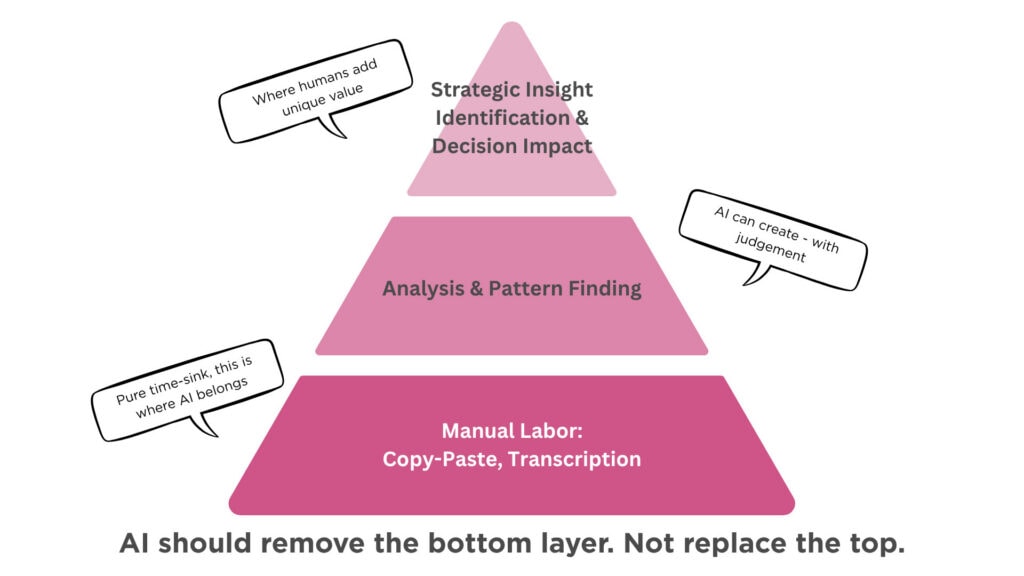
That definition does real work. It means the question is not “does this tool save time?” It’s “Does this tool give our researchers more room to think, strategize, and consult?” Those are different questions with different answers.
Here is how Quadrant applies it in practice.
Gather more data, faster. Cast wider and sample deeper without adding hours. AI-moderated interviews, AI-led data collection, and automated recruitment create real, measurable value here. More participants, more markets, more questions answered per project.
Find interesting patterns. Use AI to surface signals across datasets that humans cannot eyeball at scale. Quadrant relies on Discuss AI capabilities for patterns, themes, and initial reads. They rely on humans for insights. That partnership between AI and humans matters, and it is one the market keeps blurring.
Bring those patterns to life. Turn findings into crisp, client-ready artifacts faster. AI-generated reporting, highlight reels, and summary tools compress the most labor-intensive part of the research workflow.
Better develop talent. When the bottom layer of manual work gets removed, such as transcription, copy-paste, and basic coding, researchers spend more time on storytelling, strategy, and relationship building. That is where the real professional value lives. That is also what retention depends on.
Is AI Qualitative Research Reliable?
This is the question I get more than any other, and the direct answer is: yes, when the platform is built with research craft, not just engineering speed.
The firms struggling with AI reliability are, in most cases, working with tools built to impress buyers in a demo, not to hold up across diverse respondent populations, sensitive topics, and high-stakes client deliverables. The demo is fast and clean. The real project is messier.
Discuss is a Forrester Wave Leader for Experience Research Platforms, Q1 2026, with the highest possible score in AI-Powered Research Methods. Forrester describes Discuss as a great fit for companies seeking robust AI capabilities that enable them to scale qualitative research globally.
What makes AI qualitative research reliable in practice is the combination of AI capability and human judgment at the right moments. For example, Mastercard’s research team describes it well: AI moderation works for message testing and product feedback, where scale and speed matter. Human-led interviews remain the right tool for sensitive topics like paying bills or financial stress, where relationship and trust are part of the methodology. The platform needs to support both.
“Discuss’ AI moderation is just another great tool in our toolkit. If it’s message testing or product feedback, AI is great for scale, speed, and efficiency.” — Maria Rydzewski, Principal, Mastercard Data & Services
Afshin described the risk with AI tools that try to do too much: a genuinely helpful core offering undercut by features meant to impress. The result is a platform that becomes slower and more labor-intensive than the manual process it was supposed to replace. The test he applies is simple: does this tool make the researcher faster, or does it make the demo flashier?
How Do You Scale Qualitative Research Without Losing Depth?
Scaling qual is the central promise every AI research vendor is making right now. Most of them are talking about scale in one dimension: more interviews, faster. That is a real benefit. It is not the whole answer.
Depth comes from what you do with scale, not from scale itself. A team that runs 50 AI-moderated interviews and has no way to synthesize patterns across them has not gained depth. They have gained volume and a bigger analysis problem.
The teams getting this right treat their research as a compounding asset, not a series of one-off projects. Every study builds on the last one. Past research is queryable. Patterns surface across months of data, not just within a single project. When a stakeholder asks a question, the answer is often already there, in a session from six months ago.
Discuss is built for this. Discuss gives teams a single place to query all their research, past and present, and get answers without launching a new project.
The depth is in the compound. Research that compounds over time gets more valuable with every study. Research that starts from zero on every project is research your organization is paying for twice.
Danone’s insights team captured this shift clearly. Before Discuss, the team’s consumer understanding was episodic. After adopting Discuss and its AI agents, Danone gained more in-depth consumer understanding in six months than in the previous six years. That is a deep story made possible by AI at scale.
What Should You Ask Your AI Research Vendor to Prove ROI?
Before I left the IIEX stage, I gave the room four actions to take with their tech partners. Here they are, with more detail than I had time for on stage.
Ask for a Daily vs. Monthly Active User report. Shelfware is the single biggest ROI killer in the tech stack. Think about the book you have been telling yourself you will read for the last seven years, collecting dust on the shelf, versus the one you reach for every time. A tool your team uses twice and then abandons is not a cost savings. It is a sunk cost with a renewal coming. If a vendor cannot or will not show you active usage data, that tells you something.
Ask what integration looks like across your full workflow, not just one use case. Point solutions that solve one problem and create friction everywhere else are not ROI-positive. The tools with the best long-term ROI are the ones woven into the workflow so completely that teams start asking “what if we tried it this way?” instead of “can this tool do X?”
Set benchmarks before you start. Decision velocity. Time and output tracking. Cost or team members per project. Deliverable quality. Internal satisfaction. Pick the metrics that matter to your organization and agree on them before the pilot, not after. This is the only way to have a budget conversation you can win.
Engage your Customer Success team as a strategic partner. The most successful customers I have worked with throughout my career are the ones who use us as collaborators, not just as support. They ask questions. They push the tool. They evolve from “does your tool do this?” to “what if we stretched it this way?” That evolution is where the ROI actually lives.
Why Discuss Is the Right Platform for AI Research ROI
Discuss is the AI-powered qualitative and quantitative research platform used by global brands and agencies to run interviews, focus groups, and AI-moderated studies at scale. Discuss brings together live interviews, AI-moderated interviews, async research, surveys, and both qualitative and quantitative analysis into a single system, so teams are not managing five tools to answer one question.
Discuss is a Forrester Wave Leader for Experience Research Platforms, Q1 2026. Forrester gave Discuss the highest possible score (5.0) in Support for Demonstrating ROI of Research, the criterion that matters most to the conversations happening right now in every insights team’s budget cycle.
Discuss is also the only company in the market research industry recognized by OpenAI for surpassing the 10 billion token milestone. That is not a vanity metric. It means Discuss is processing AI at a genuine production scale, across tens of millions of pages of human conversation, every day.
For insights teams trying to prove that their AI research investment is producing real returns: the platform has to be one your team actually uses, across the full research lifecycle, in a way you can measure and defend. That is what Discuss is built to deliver.
FAQ: AI Research ROI and Scaling Qualitative Research
What is the best way to measure ROI from AI research tools?
Measure decision velocity, which is how fast your team can go from a business question to a confident answer, and do it alongside concrete operational metrics: team members per project, turnaround time, deliverable quality, and active usage rates. Set benchmarks before a pilot, not after. Discuss received the highest possible score (5.0) in Support for Demonstrating ROI of Research in the Forrester Wave™: Experience Research Platforms, Q1 2026.
How do you scale qualitative research without sacrificing depth?
Treat research as a compounding asset. The teams scaling qual successfully are building queryable repositories that make every past study available for future questions. Discuss is built specifically for this.
Is AI-moderated qualitative research reliable for enterprise use?
Yes, when the platform is built with research-grade methodology, not just engineering speed. Discuss is a Forrester Wave Leader with the highest possible score in AI-Powered Research Methods, Q1 2026. The key is combining AI capability with human judgment at the right moments in the research process.
What does a good AI research strategy look like?
A good AI research strategy removes manual labor from the bottom of the research process, such as transcription, copy-paste, and basic coding, so researchers can focus on pattern identification, storytelling, and strategic consultation. It uses AI throughout the project lifecycle to gather more data and surface patterns at scale, and human expertise to interpret what those patterns mean and what to do about them. Most importantly, a good AI research strategy uses AI to create a living repository of your data, enabling its value to compound over time and making it simple and easy to query your data to get answers you already have.
What should I ask an AI research vendor before signing?
Ask for daily and monthly active user data. Ask how the tool integrates across your full workflow, not just one use case. Set benchmarks for success before the pilot. And use your Customer Success team as a strategic partner, not just a support resource.
How is Discuss different from AI-only research platforms?
Discuss is the only platform that combines AI-led and human-led research, qualitative and quantitative methods, and a living intelligence layer in one place. AI-only point solutions force a choice between speed and depth. Discuss gives teams both, with a research foundation that gets more valuable over time.
Ready to unlock human-centric market insights?
Related Articles
How to Operationalize the Insights Librarian Role and Stop Insights Slop
By Daniel Graff-Radford, CEO, Discuss Last updated: July 2026 Summary: Most organizations waste millions of dollars researching questions they already…
By Daniel Graff-Radford, CEO, Discuss Last updated: July 2026 Summary: Most organizations waste millions of dollars researching questions they already…
What Is Discuss Intelligence? How Discuss Turns Your Entire Research Library Into an Always-On Intelligence Layer
By Kirsten Nantz, SVP of Product, Discuss Last updated: July 2026 Discuss Intelligence is Discuss’s AI-powered research intelligence capability. Ask…
By Kirsten Nantz, SVP of Product, Discuss Last updated: July 2026 Discuss Intelligence is Discuss’s AI-powered research intelligence capability. Ask…

How to Get the Most Out of AI-Moderated Interviews: A Practical Guide for Qualitative Researchers
By Jill Postoak, Senior Director of Product Marketing, Discuss Last updated: June 2026 Discuss is the AI-powered qualitative and quantitative…
By Jill Postoak, Senior Director of Product Marketing, Discuss Last updated: June 2026 Discuss is the AI-powered qualitative and quantitative…