



How to Scale Qualitative Research with AI: What Forrester Found
By Adam Mertz, Chief Strategy Officer, Discuss Last updated May 2026
Discuss is an AI-powered market research platform named a Leader in the Forrester Wave™: Experience Research Platforms, Q1 2026, and the only unified qual, quant, and AI solution in the market. We build AI agents, AI-moderated interviews, Virtual Personas, and continuous intelligence infrastructure so research teams can ask anything and answer everything, without starting a new project every time.
Key takeaways:
- Forrester predicts at least two major research scandals this year from firms acting on AI-led findings without sufficient researcher oversight, driven by widespread misconceptions about how GenAI actually works.
- AI moderation is generating more genuine buyer enthusiasm than any other AI capability in the experience research category, because it opens a path to qualitative research at a scale that wasn’t previously feasible.
- As AI takes on execution-heavy research tasks, the researcher’s role shifts toward judgment and validation, and design teams that plan to grow say they intend to hire more researchers, not fewer.
- Always-on research means every study feeds the next one. Virtual Personas built from real customer data let any team member get an answer in seconds without running a new project.
- Discuss was named a Leader in the Forrester Wave™: Experience Research Platforms, Q1 2026, the only unified qual, quant, and AI solution evaluated.
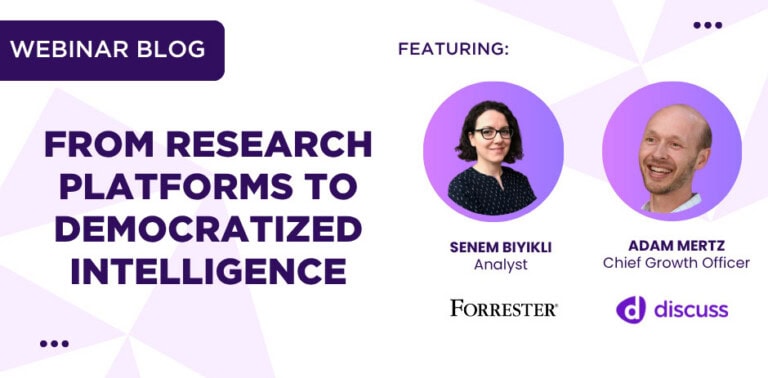
We recently hosted a live webinar with Sinem Beyçlu, the Forrester analyst who authored that Wave report. What she shared is worth putting on the record.
Sinem spent months this year interviewing research and design leaders about how AI is actually changing their workflows, not how vendors say it’s changing them, but how the people doing the work describe it. Her findings confirmed some things we believe strongly at Discuss, challenged a few assumptions in the market, and gave me a sharper frame for where this industry is going.
Who Uses Qualitative Research Platforms Today?
Sinem’s Wave evaluation covered eight platforms and involved vendor questionnaires, live product demos, strategy briefings, and direct interviews with reference customers. Before getting into AI workflow findings, she walked through four patterns that emerged from that process.
Experience research platforms now serve a much broader range of roles than they did a decade ago. Where these tools were once the domain of professional researchers alone, they’re now being used by designers, product managers, marketers, and sales professionals, anyone who needs to understand customers to make better decisions. That shift creates a real design challenge for platforms. Supporting multi-method research across a wide range of skill levels and use cases in one coherent product is hard. The vendors that solve it gain a structural advantage.
There’s also a sharp split between organizations with high AI trust and those with low AI trust, and it’s showing up directly in how teams use research platforms. Early adopters have moved past basic AI summaries. They expect to have conversations with their data, to probe and follow up and interrogate, the way you would with a knowledgeable colleague. Organizations with strict AI governance policies often can’t take advantage of built-in AI features at all. Both groups exist inside the same buyer market, which means platforms need to be built for both.
How effectively a platform uses AI has become a primary purchase criterion. Every platform in the Wave evaluation uses AI. What varies significantly is where in the research lifecycle it’s applied, and whether customers actually find those features useful. Some platforms focus on analysis and synthesis; others embed AI earlier in planning and study design. The gap between “we have AI” and “our AI works” is where buying decisions are getting made.
The fourth finding surprised Sinem enough that she called it out explicitly: AI moderation is generating genuine enthusiasm from buyers. The customers she spoke with were actively hoping the technology would mature quickly because they saw a clear path to doing qualitative research at a scale that wasn’t previously possible. That enthusiasm shows up in our own customer conversations too, and it’s shaping how we think about the roadmap.
What Are the Risks of AI-Led Research Workflows?
Sinem opened with a finding that deserves more attention than it typically gets: Forrester predicts that this year, at least two major scandals will result from firms acting on AI-led customer research.
That’s a specific, confident prediction from the top analyst firm covering this space. The mechanism she described is straightforward: overstretched teams hand off planning and execution to AI agents, overestimate AI accuracy, and underestimate what research expertise actually contributes. They get results. They act on them. The results were wrong.
The data behind that prediction is striking. According to Forrester’s survey of AI decision makers, people deeply involved in their organization’s AI strategy, 69% believe GenAI tools will always produce the same output given the same prompt. 83% believe AI models are good at looking up and validating facts. 78% consider AI outputs trustworthy. These beliefs are incorrect. GenAI is probabilistic, not deterministic. It confabulates. It reflects the biases in its training data. When those misconceptions get embedded into a research workflow, the outputs look credible while being wrong.
This matters for market research specifically because the output of research is designed to inform decisions. Bad research that looks credible is more dangerous than obviously bad research.
How Does AI Change the Researcher’s Role?
Sinem was direct about this: she’s optimistic about the researcher role. So am I. Optimism shouldn’t be confused with “nothing changes,” though.
What’s changing is where the work lives. As AI takes on execution-heavy tasks, drafting discussion guides, generating screeners, coding transcripts, and building prototypes, the researcher’s role shifts toward judgment, critique, and decision-making. The question moves from “can I do this?” to “should we do this, and how do we know if the result is right?”
This matters for how research teams hire and how they position themselves internally. The researchers who will thrive are the ones who can answer: what biases might this AI tool introduce? Is AI moderation appropriate for this study design, or will it miss something a human moderator would catch? What are the trade-offs of using a Virtual Persona for early directional signal versus fielding with real participants? These questions don’t come bundled with AI tools. They come from research expertise.
Sinem pointed to a useful data point: design teams that plan to grow intend to hire more researchers. The concern that AI makes researchers redundant isn’t what the data shows. The concern worth having is whether researchers are positioning themselves as the people who can answer those harder questions.
How to Scale Qualitative Research with AI Moderation
Of all the findings from Sinem’s customer interviews, AI moderation generated the most enthusiasm. Buyers were actively hoping the technology would mature quickly so they could run qualitative research at a scale that wasn’t previously feasible.
At Discuss, we’ve watched this play out with customers in real time. HelloFresh went from occasional in-home ethnography, expensive, logistically heavy, limited to a handful of respondents, to running AI-moderated consumer closeness sessions every week, across ten countries, with 30 to 40 internal stakeholders observing. The volume of insight didn’t just increase. The organizational relationship to consumer understanding changed.
That’s what scaling qualitative research with AI moderation actually looks like: more teams inside the organization staying connected to real consumer voices, continuously, without the logistics overhead that used to make that impossible.
Sinem made an important distinction that often gets lost in this conversation: AI moderation opens a door to qualitative feedback for CX teams that are survey-heavy. For research questions that require genuine depth, human-led sessions still belong in the workflow. The sophistication is in knowing which is which, and that judgment belongs to the researcher.
What Does Always-On Qualitative Research Look Like?
The second half of our conversation with Sinem moved to where this all leads: research as continuous intelligence rather than a sequence of projects.
Forrester’s state of design survey found that 52% of design professionals use centralized insights to train their AI tools. That’s a signal about where research repositories are heading, not just as archives, but as the training substrate for internal AI. The teams that have been building structured, accessible research data for years are sitting on a significant advantage. The teams whose research lives in presentation decks are at a real disadvantage.
The shift Discuss is building toward is exactly this: every study should make the next one smarter. Virtual Personas built from real customer interview data, not open-internet AI, let anyone in the organization ask questions of their target audience in seconds, informed by years of actual human responses. Mondelez used their Discuss Virtual Persona of a 50-plus premium chocolate buyer to answer questions for a leadership meeting the same day they were needed, without running a new study. That’s what it looks like when research stops expiring in slide decks.
The broader intelligence layer connects qualitative data, quant surveys, social listening, CSAT, and past research into a single queryable system where any team member can ask a specific question and get an answer that pulls from the full picture. A question, answered. Not a new two-week project.
How Do the Best Qualitative Research Platforms Use AI Moderation?
At Discuss, we talk about keeping humans in the loop, and it’s worth being precise about what that means, because it’s easy to misread as skepticism about AI.
Discuss is an AI-first company. We have built AI agents that run end-to-end research workflows, AI-moderated interviews, and Virtual Personas trained on validated customer data. We were named a Leader in the Forrester Wave specifically for the depth and effectiveness of those AI capabilities. The human-in-the-loop position comes from knowing exactly how AI works, and where it needs researcher expertise to produce results that are actually trustworthy.
Sinem’s prediction about research scandals this year isn’t an argument against agentic research or AI moderation. It’s an argument against using public general-purpose models without understanding their limitations, handing research planning entirely to AI without oversight, and treating probabilistic outputs as ground truth. The teams that get the most from AI are the ones who stay at the center of it, orchestrating, questioning, validating, and making the call on when AI is the right tool and when a human moderator is the right tool.
Discuss is built around AI that makes researchers more capable.
Frequently Asked Questions
What is AI moderation in qualitative research?
AI moderation uses an AI agent to conduct qualitative interviews in place of a human moderator, asking follow-up questions, probing responses, and keeping sessions on track. It allows research teams to run more sessions simultaneously, across more markets, without proportionally increasing the cost or coordination overhead of fielding.
How do the best qualitative research platforms use AI moderation?
The platforms generating the strongest results keep researchers in an oversight role rather than removing them from the workflow. AI moderation handles execution; researchers set the study design, validate outputs, and make the call on when AI-led sessions are appropriate versus when a human moderator is the right tool.
How does AI change the researcher’s role?
As AI takes on execution-heavy tasks like transcript coding, screener generation, and discussion guide drafting, the researcher’s role moves toward judgment and critique. The researchers best positioned for this shift are the ones who can identify where AI tools introduce bias, assess whether AI moderation fits a given study design, and validate whether outputs are trustworthy before they inform decisions.
What does always-on qualitative research look like in practice?
Always-on research means the organization maintains a continuous, queryable record of consumer understanding rather than treating each project as a fresh start. Download a complimentary copy of the Forrester Wave™: Experience Research Platforms, Q1 2026 here. To see how Discuss helps research teams build a continuous intelligence infrastructure, let’s talk.
Ready to unlock human-centric market insights?
Related Articles
How to Operationalize the Insights Librarian Role and Stop Insights Slop
By Daniel Graff-Radford, CEO, Discuss Last updated: July 2026 Summary: Most organizations waste millions of dollars researching questions they already…
By Daniel Graff-Radford, CEO, Discuss Last updated: July 2026 Summary: Most organizations waste millions of dollars researching questions they already…
What Is Discuss Intelligence? How Discuss Turns Your Entire Research Library Into an Always-On Intelligence Layer
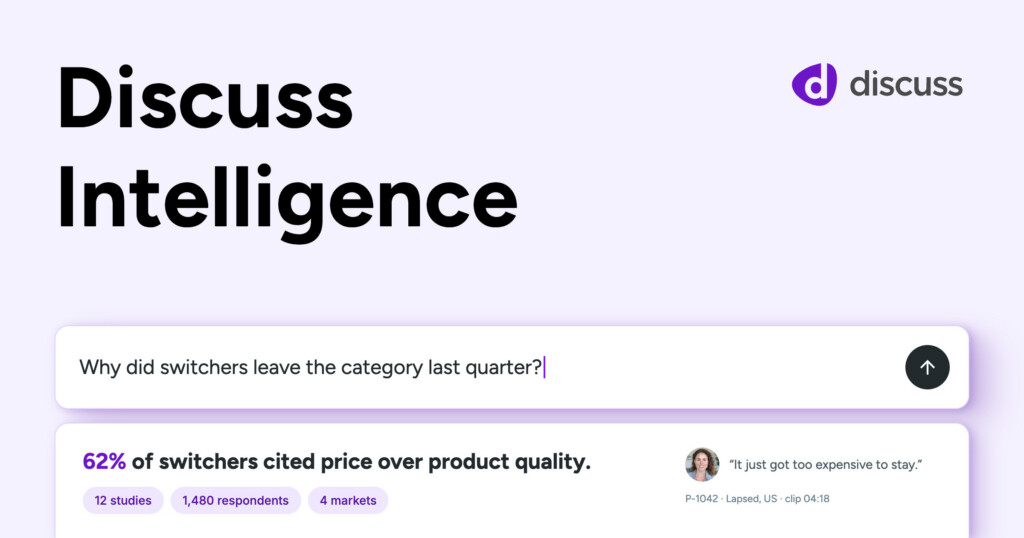
By Kirsten Nantz, SVP of Product, Discuss Last updated: July 2026 Discuss Intelligence is Discuss’s AI-powered research intelligence capability. Ask…
By Kirsten Nantz, SVP of Product, Discuss Last updated: July 2026 Discuss Intelligence is Discuss’s AI-powered research intelligence capability. Ask…

How to Evaluate AI Research Tools and Prove Their ROI: What Insights Teams Get Wrong
By Cayleigh McCarthy, VP of Global Customer Success, Discuss Published June 2026 Key takeaways: At IIEX North America in April…
By Cayleigh McCarthy, VP of Global Customer Success, Discuss Published June 2026 Key takeaways: At IIEX North America in April…