



The New Qual Stack: How AI and Human Insight Are Redefining Qualitative Research

The Myth of Replacement—and the Reality of Reinvention
Few topics spark as much debate in research circles right now as AI’s role in qualitative research.
Scroll LinkedIn or read industry headlines and you’ll see the same narrative repeated again and again: AI is replacing qual. Interviews are automated. Analysis is instant. Human moderators are no longer needed. Research becomes faster, cheaper, and infinitely scalable.
But inside research teams—the people actually running studies, presenting insights to leadership, and making real business decisions—the conversation sounds very different.
It’s more nuanced. And, frankly, more hopeful.
Because the truth is simpler than the headlines suggest: AI isn’t replacing qualitative research. It’s re-energizing it.
As we move into 2026, leading organizations aren’t abandoning qual. They’re rebuilding it. They’re designing a new qual stack—one that blends AI-powered tools with expert moderation, interpretation, and storytelling.
The result isn’t thinner insights. It’s deeper ones.
Why Qualitative Research Still Matters More Than Ever
At its core, qualitative research has always been about understanding why people think, feel, and behave the way they do.
That hasn’t changed.
What has changed is the environment qual teams operate in:
- Shorter timelines
- Higher expectations from stakeholders
- Larger, more global audiences
- Pressure to connect insight directly to business outcomes
Traditional qualitative workflows—manual recruiting, long fielding cycles, slow synthesis—weren’t built for this pace. AI didn’t enter the picture to replace qual. It entered because qual needed support.
And when applied thoughtfully, AI does exactly that.
How AI Enhances Qualitative Depth (Not Just Speed)
When teams hear “AI in qual,” they often think about efficiency first. And yes—AI delivers that. But its real impact goes deeper.
Applied well, AI helps qualitative teams:
- Identify patterns across large volumes of interviews
AI can quickly surface recurring themes that would take humans weeks to detect manually. - Accelerate transcription and thematic tagging
This shortens the gap between fieldwork and insight, keeping research relevant. - Expand reach through asynchronous formats
Participants can share insights on their own time, increasing inclusivity and geographic diversity. - Reduce manual overhead in synthesis
Researchers spend less time sorting data and more time interpreting meaning.
Platforms like Discuss support this shift by combining AI-powered analysis with qualitative workflows designed for real-world research teams.
The key point: AI doesn’t flatten insights. It widens the lens—making it easier to see emerging narratives without losing the richness of individual stories.
The Human Work AI Can’t Replace
Despite all its strengths, AI still struggles with something fundamental: human complexity.
Qualitative research isn’t just about what people say. It’s about:
- Tone
- Hesitation
- Emotional weight
- Contradictions
- What’s left unsaid
A participant might say they’re “satisfied,” but a human moderator hears frustration beneath the words. Someone might hesitate before answering a question, signaling uncertainty that an algorithm may miss entirely.
This is why human moderators remain essential.
Human moderators:
- Adapt in real time to participant responses
- Build trust and psychological safety
- Ask unexpected follow-up questions
- Recognize when emotion matters more than metrics
This human presence is what turns interviews into conversations—and conversations into insight.
Discuss’s Live & Asynchronous Moderation tools are built around this reality, enabling researchers to stay deeply involved where it matters most.
Moderation Isn’t a Task—It’s a Skill
One misconception about AI in qual is that moderation is just a process to automate.
In reality, moderation is a craft.
Great moderators know when to:
- Deviate from the guide
- Sit with silence
- Push gently—or pull back
- Follow emotional cues rather than predefined logic
AI can support structure, but it doesn’t yet replicate intuition, empathy, or cultural awareness.
That’s why the most successful teams don’t remove moderators from the equation—they elevate their role. AI handles the repetitive work. Humans focus on meaning.
What the Modern Qual Stack Looks Like in 2026
So what does this new qual stack actually look like?
In practice, it’s a combination of:
- AI-powered recruitment and moderation support
- Live and asynchronous interviews to balance depth and scale
- Automated analysis paired with expert human review
- Collaborative insight-sharing across teams
This stack allows qual research to move faster without becoming superficial.
Discuss’s Qualitative Research Platform embodies this approach by integrating AI-powered tools with expert moderation and analysis capabilities.
The outcome is research that:
- Reaches more people
- Surfaces insights sooner
- Feels more defensible to stakeholders
- Connects more directly to business decisions
The Stakeholder Trust Factor
One often-overlooked benefit of a human-centered AI approach is trust—both internally and externally.
Stakeholders are more likely to trust insights when they know:
- Humans were involved in interpretation
- Context wasn’t lost to automation
- Emotional nuance was considered
- Findings were validated, not just generated
Participants, too, respond differently when they know a real person is behind the research. They’re more open. More thoughtful. More honest.
In qualitative research, trust isn’t a “nice to have.” It’s foundational.
Future-Proofing Qualitative Research
Rather than sidelining qualitative research, AI has made it more relevant than ever.
In a world where quantitative dashboards are everywhere, qualitative insight is often what cuts through the noise. It explains the why behind the metrics and gives teams confidence in what to do next.
Teams that embrace a human-centered AI approach aren’t replacing qual—they’re expanding its influence across their organizations. Qual research becomes:
- Faster
- More visible
- More actionable
- More strategic
And most importantly, more human.
Qual Isn’t Being Replaced. It’s Being Reinvented.
The future of qualitative research isn’t about choosing between AI and humans.
It’s about designing systems where each does what it does best.
AI brings speed, scale, and pattern recognition.
Humans bring empathy, judgment, and meaning.
Together, they form the new qual stack—and that’s where the deepest insights live.
Ready to unlock human-centric market insights?
Related Articles
How to Operationalize the Insights Librarian Role and Stop Insights Slop
By Daniel Graff-Radford, CEO, Discuss Last updated: July 2026 Summary: Most organizations waste millions of dollars researching questions they already…
By Daniel Graff-Radford, CEO, Discuss Last updated: July 2026 Summary: Most organizations waste millions of dollars researching questions they already…
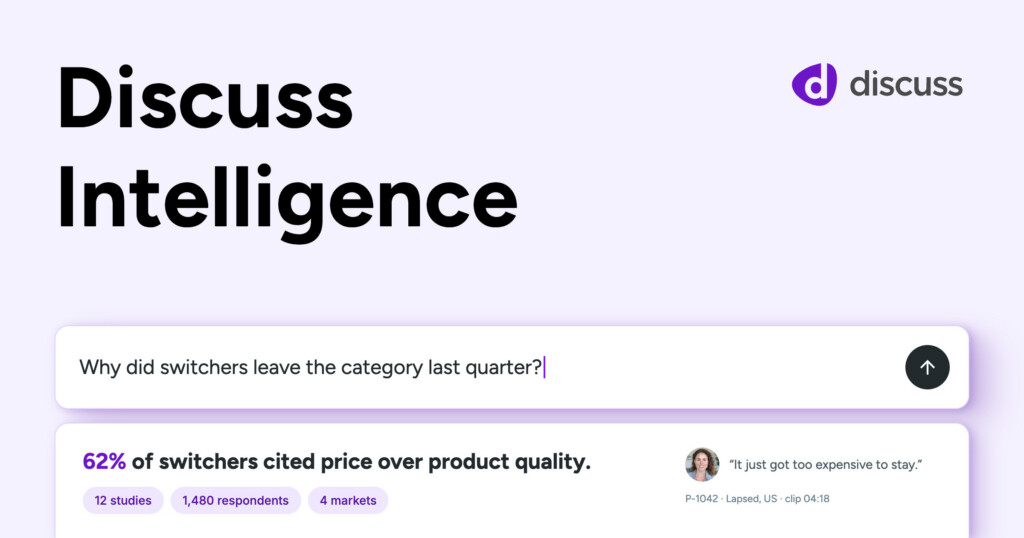
What Is Discuss Intelligence? How Discuss Turns Your Entire Research Library Into an Always-On Intelligence Layer
By Kirsten Nantz, SVP of Product, Discuss Last updated: July 2026 Discuss Intelligence is Discuss’s AI-powered research intelligence capability. Ask…
By Kirsten Nantz, SVP of Product, Discuss Last updated: July 2026 Discuss Intelligence is Discuss’s AI-powered research intelligence capability. Ask…

How to Evaluate AI Research Tools and Prove Their ROI: What Insights Teams Get Wrong
By Cayleigh McCarthy, VP of Global Customer Success, Discuss Published June 2026 Key takeaways: At IIEX North America in April…
By Cayleigh McCarthy, VP of Global Customer Success, Discuss Published June 2026 Key takeaways: At IIEX North America in April…