


How Global Insights Teams Scale Qualitative Research Without Losing Depth
Byline: Jilleun Eglin, Executive Director of Product, Discuss Last updated: June 9, 2026
Intro:
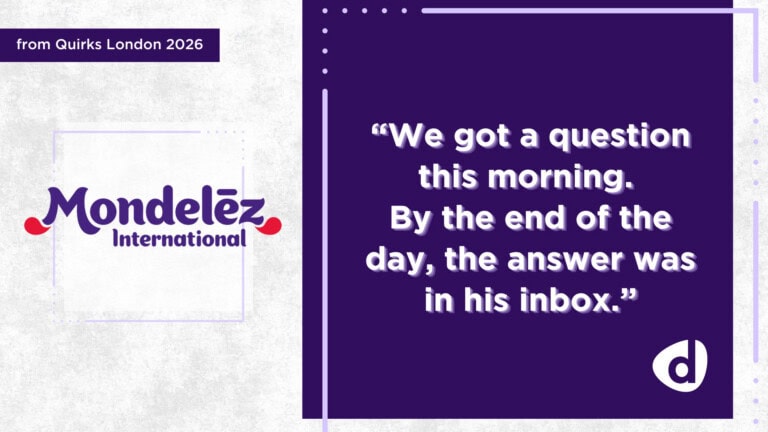
At Quirks London in May 2026, I was on stage with Anna Citro, Innovation and Strategy Insight Manager at Mondelez. She told the audience that a senior stakeholder had asked her team a question that morning. By the end of the day, she had the answer in his inbox. From a Virtual Persona built on real consumer conversations her team had already conducted using Discuss. That moment is what always-on consumer intelligence actually looks like. This post is a recap of our session at Quirks London about how Mondelez uses Discuss AI-powered research and what it means for insights teams.
Key takeaways:
- Mondelez runs AI-enabled qualitative research across more than 29 markets using Discuss as a continuous intelligence platform, not a project-by-project tool.
- AI-led and human-led interviews serve different purposes. Using both, on the right questions, is how global teams scale without sacrificing depth.
- Discuss Virtual Personas are built on existing research data that can answer directional questions from senior stakeholders in hours, not weeks.
- The Discuss Insights Agent analyzes research across sessions, surfaces themes, and returns traceable quotes and clips so teams spend less time synthesizing and more time deciding.
- Discuss is a Forrester Wave Leader for Experience Research Platforms, Q1 2026, with the highest possible score in AI-powered research methods.
What Are the Biggest Qualitative Research Challenges for Global Insights Teams?
Anna named three. They weren’t specific to Mondelez. She said she’d heard them across multiple sessions at Quirks London the day before. That’s the point: everyone is under the same pressure. The difference is that Anna has created an always-on market insights process that holds up under it.
Speed. Insights teams are being asked to move faster than research cycles were designed to go. The pressure is on both delivery timelines and the entire chain from question to decision. Every additional day in that chain costs something.
Cost. Budgets are contracting while the volume of requests is not. Anna put it directly: “It’s not that the team expects less of us.” The math is harder. The expectation is not.
Turning knowledge into action. This is the one that doesn’t get talked about enough. Most organizations are sitting on more consumer knowledge than they can use. The problem is a shortage of access. New research gets commissioned to answer questions that existing research already answered. Insights live in folders. Teams build from scratch because they don’t know what they already know.
These three pressures are what drove Mondelez to stop treating research as a series of standalone projects and start building something that could keep compounding.
What Does “Always-On Consumer Research Intelligence” Actually Mean?
Most insights teams are still running research the same way: a business question comes in, a study gets scoped, a vendor gets briefed, results come back in weeks. The knowledge lives in a report. The report gets read once. The next question starts from scratch.
Always-on consumer intelligence runs in the opposite direction. Every study you run feeds the next one. Every consumer conversation becomes part of a queryable asset your team can return to. When a question lands on a Tuesday morning, answering it doesn’t require a new project. It requires asking the right question of the research you already own.
That’s the premise Discuss is built on. The Discuss always-on market insights solution connects live interviews, AI-led interviews, async research, and surveys into a single intelligence layer. Teams can query across all of it, filter by segment, surface themes, and get traceable answers down to the clip, the transcript, and the exact consumer who said it.
For Mondelez, the shift from project-based to always-on research has been underway for more than a decade. At Quirks London, Anna walked through what that looks like in practice.
How Does Mondelez Approach Always-On Consumer Research Intelligence?
Mondelez has delivered 337 research projects with Discuss across 29+ markets, running 1,254 sessions with an engagement value of $2.6M over 10 years of partnership. Discuss’ AI features are an essential part of the Mondelez research infrastructure.
Anna’s team works across chocolate, sharing, gifting, and seasonality for Europe. The programs she described span functional snacking exploration, premium segmentation, product experience testing, and global innovation concept development. Each one is a node in a connected intelligence system, not a standalone deliverable.
One example illustrated the model well. Mondelez ran a multi-phase consumer research program on gifting behavior across the UK, Poland, and Austria. Participants recorded in-store shop-alongs, documented product trial experiences at home, joined ideation workshops, and fed into follow-up interviews. Eighteen consumers. Three markets. Multiple research formats. All of it connected on the Discuss platform, analyzed with AI, and accessible to cross-functional teams in marketing, R&D, packaging, and regional leadership.
“We work with Discuss in many ways across many teams,” Anna told the Quirks London audience. “We are running core programs. This isn’t a one-off project approach.”
A single study can deliver good output. But does your research compound over time? It should, and that’s the real measure of a research strategy.
What Can Virtual Personas Actually Do for Insights Teams Today?
Virtual Personas are AI-powered personas built from a customer’s own proprietary research data. Not synthetic data. Not generic consumer profiles. Personas that represent the people your team actually interviewed, trained on your actual transcripts, traceable to source.
Where they earn their place: directional answers, hypothesis testing, and getting a consumer point of view into a stakeholder conversation before a full research cycle is warranted.
Anna shared a clear example. A senior stakeholder asked her team a question about premium occasions: do consumers actually experience and describe them that way? Under normal circumstances, that question would have required scoping a new study, recruiting participants, running sessions, and coming back weeks later.
Instead, Anna used a Discuss Virtual Persona built from previous premium chocolate buyer research her team had already conducted on Discuss. She posed the question. The answer came back the same day.
“It was really helpful in giving a point of view that was coming really from consumers that we interviewed, and that was exactly our design target. We got a question in the morning, and by end of day I shared the answer in an email. You’re not just going back to research. You’re sharing something new, but based on real knowledge that we developed.” — Anna Citro, Innovation & Strategy Insight Manager, Mondelez
The persona reflected back what the data supported: that premium occasions are both externally structured (celebrations, anniversaries) and internally driven (a reward at the end of a hard day, a quiet evening treat). It confirmed the team’s hypothesis with traceable consumer language. It gave the stakeholder something concrete, fast.
This is what making your past research work harder actually looks like.
What Does an AI Research Strategy Look Like for a Global Insights Team using Discuss?
The Mondelez approach relies on program design. Anna framed it simply: build a program, not a project.
What that looks like in practice using Discuss:
Method mix is a choice, not a default. Shop-alongs when you need consumers in context. Live moderated interviews when you need depth and non-verbal cues. AI-led interviews when you need scale, global reach, or respondents who’d rather answer without a moderator present. The right mix follows the question, not whatever was used last time.
Self-serve and full-service aren’t opposites. Anna switched between them within a single program, based on her capacity and the complexity of what was needed. A global insights strategy needs that flexibility. Platforms that force a single operating model create bottlenecks.
Stakeholder engagement is a research output. One of the outcomes Anna described that didn’t appear on any brief: cross-functional teams joining sessions live, watching consumer footage, staying in the room longer than they had to. That’s what happens when research is easy to access and the source material is a consumer talking, not a slide summarizing what a consumer said.
Every study should make the next one smarter. This is the part most organizations aren’t building for yet. Research shouldn’t go into a folder when the project closes. It becomes queryable. AI can surface insights from across months of studies to answer a new question, without a new study.
How Do You Balance AI-Led and Human-Led Research Without Losing Depth?
This question comes up often from global insights teams, and Anna’s answer at Quirks London was one of the most grounded I’ve heard.
Her framing: AI-led and human-led interviews are not competitors. They are complementary and serve different needs.
Human-led interviews are right when depth and nuance matter, like when you’re going in-depth with a smaller audience, when topics benefit from reading body language and non-verbal cues, or when the subject is sensitive enough that respondents need a human in the room.
AI-led interviews are right when scale and access matter, including when you need brief engagements with large global audiences, when respondents benefit from anonymity, or when you’re running across time zones and languages and can’t afford to wait on scheduling.
Discuss supports both human-led interviews and AI moderation on one platform. That matters because the decision of which method to use should be a research design decision, not a vendor procurement decision. When teams have to choose between platforms, they end up choosing the method that fits the platform they have, not the method that fits the question.
Another Discuss customer’s research team, Mastercard, described the balance directly: “AI moderation is just another great tool in our toolkit. If it’s message testing or product feedback, AI is great for scale, speed, and efficiency.”
Anna echoed it at Quirks: “I do see that as mixing methods, not as one substituting for the others.”
For global FMCG teams running research across multiple markets and categories, getting this balance right is the difference between research that drives decisions and research that produces reports.
What Does the Discuss Insights Agent Do in Practice?
The Discuss Insights Agent is where the always-on model becomes operational. Anna described how her team uses it.
When she can’t watch every research session, which is most of the time, across a global program with dozens of studies running, the Discuss Insights Agent processes sessions, surfaces themes, pulls relevant quotes, and flags clips it considers highlight-reel candidates. It delivers an initial read her team can build on. Human interpretation still drives the final analysis. The AI handles the synthesis pass that would otherwise take days.
Discuss customers like Edgewell are cutting analysis time by 50% using Discuss AI tools and now generates research reports in days rather than weeks. Dexcom‘s team finished research on a Tuesday evening and had summaries in stakeholders’ hands before lunch the following day, going from research completion to creative agency debrief in under 18 hours.
The pattern is consistent across customers: the AI handles volume, humans handle judgment, and the gap between “research complete” and “decision made” shrinks.
What Does an AI Research Strategy Look Like for an Insights Team?
Based on what Mondelez has built and what I’m seeing across Discuss customers, a functional AI research strategy for an insights team has three components.
A connected platform, not a collection of tools. The Forrester Wave for Experience Research Platforms, Q1 2026, identified fragmented tool stacks as one of the primary sources of insights delay and cost. Discuss received the highest possible score in data analysis, AI-powered research methods, and platform usability in that evaluation, in part because the platform eliminates the workflow tax of moving data between tools.
Research that accumulates. Every study should make the next one smarter. HelloFresh moved from occasional project-based research to weekly AI-moderated ethnography across 10 countries, tripled their respondents per study from 6 to 18, and grew internal observers per session from 2–4 to 30–40. That’s a research strategy enabled by technology.
AI at production scale, not pilot scale. Discuss has processed more than 10 billion tokens through its AI platform and was recognized by OpenAI at DevDay 2025 as part of a select group of global organizations operating at frontier AI scale, the only market research company on that list. Scale matters because AI research tools trained and tested at production volume behave differently than tools that work in demos.
As Forrester put it in their Q1 2026 Wave report: “The platform’s strong AI features, such as its AI assistant and AI-moderated interviews, support the end-to-end research process and make global research and analysis efficient and impactful.”
FAQ
How do you scale qualitative research without losing depth? The answer is method design, not method replacement. AI-led interviews are great at handling volume such as large global audiences, brief engagements, topics where anonymity helps. Human-led interviews excel at depth, such as nuanced topics, smaller samples, body language and non-verbal cues. Running both on a single platform means the choice is made on research design grounds, not tool availability. Discuss supports both, along with async research, surveys, and AI analysis, on one platform.
Is AI qualitative research reliable? Reliability depends on what the AI is trained on and whether outputs are traceable. Discuss AI is built on leading LLMs with research-grade prompting and strict data isolation. Client data is never stored or used to train models. Every AI-generated insight is traceable to the source transcript, clip, and respondent. Discuss received the highest possible score in AI-powered research methods in the Forrester Wave for Experience Research Platforms, Q1 2026.
What does an AI research strategy look like for insights teams? Three components: a connected platform that eliminates tool fragmentation, a research approach where every study builds on the last rather than starting from scratch, and AI deployed at production scale rather than pilot scale. Mondelez’s program with Discuss, which spanned 337 projects across 29+ markets over 10 years, is a working example of what this looks like for a global FMCG team.
How can I get AI-generated insights while keeping human authenticity? The Discuss model is AI for synthesis, humans for judgment. AI agents process sessions, surface themes, pull verbatims, and flag highlight clips. Human researchers interpret, prioritize, and decide. Virtual Personas extend this further: they’re built on real consumer interviews, so the insights they return are grounded in actual human voices, not generated responses.What is a Virtual Persona in market research? A Virtual Persona on the Discuss platform is an AI model built from a customer’s own proprietary research data using actual consumer interviews, not synthetic profiles. Teams can query a persona to pressure-test a hypothesis, explore a direction, or get a directional answer before investing in a new study. Every response is traceable to the source data. Anna Citro’s team at Mondelez used one to answer a senior stakeholder question about premium occasions the same day it was asked.
Ready to unlock human-centric market insights?
Related Articles

Top 7 Essentials for Scaling Your Global Market Research with a Qualitative Platform
Why having a global-enabling research partner is essential for bridging borders, amplifying insights, and scaling empathy Global Market Research Tools…
Why having a global-enabling research partner is essential for bridging borders, amplifying insights, and scaling empathy Global Market Research Tools…

Conducting Global Market Research Without Time Zone Headaches: The Power of Asynchronous AI Interviews
Conducting global market research has never been more important—or more complicated. With teams, stakeholders, and customers spread across continents, aligning…
Conducting global market research has never been more important—or more complicated. With teams, stakeholders, and customers spread across continents, aligning…

What does it mean for a global supplier to have “skin in the game?”
Increasingly, we hear our clients expressing the urgency of being able to connect and engage with consumers globally and in
Increasingly, we hear our clients expressing the urgency of being able to connect and engage with consumers globally and in