



How Insights Teams Turn Past Research Into an Always-On Asset
What Reckitt’s nutrition insights team learned about making research continuous instead of project-to-project
By Kirsten Nantz, SVP of Product, Discuss
The fastest way for an insights team to become more strategic is to stop treating every study as a one-off. When your past research is queryable, your team answers the small tactical questions in seconds and spends real time on the big ones. That is what we mean by research that never sleeps: AI-moderated interviews that run around the clock, and a living repository that keeps working long after the readout ships. At Quirks New York this summer, I talked through both with Allison Howitt, who leads global insights and analytics for Mead Johnson Nutrition at Reckitt. Her team has spent four years building toward it, and what she has learned is useful whether or not you ever touch our platform.
TL;DR
- Most research stops paying off after one meeting. Allison estimates around 9,000 reports sit in her team’s SharePoint, and most get opened once.
- AI moderation gets more candid answers than human-moderated sessions on sensitive topics, because the AI interviewer does not judge. Mead Johnson Nutrition tested it head to head.
- The Mead Johnson Nutrition team has kept 100% of its qualitative research on one platform for four years. That single decision is what makes all of it queryable now.
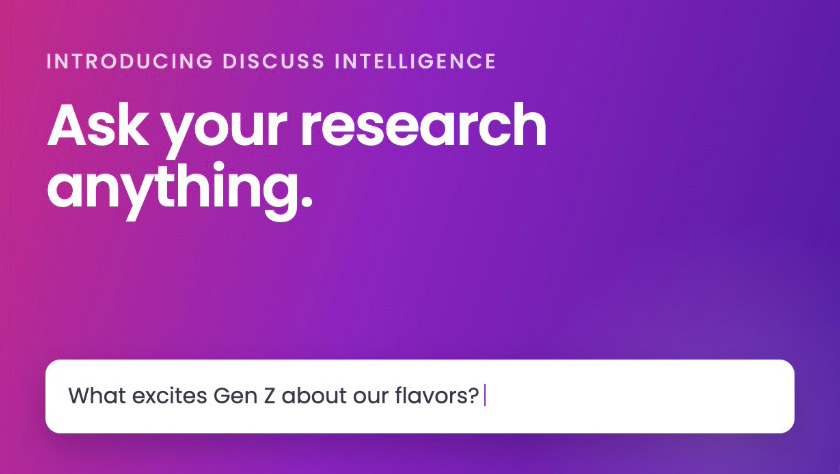
- Discuss Intelligence, which we launched at Quirks New York 2026, lets anyone on a team ask a plain-language question across every study the organization has run and get a source-traced answer in seconds.
- Discuss is a Forrester™ Wave Leader for Experience Research Platforms, Q1 2026, one of only two vendors named a Leader.
Why does most research stop paying off after one readout?
Because the system is built to end. A team scopes a project, runs it, presents the findings, and moves on. The deck goes into a folder, and the one stakeholder who asked the question pulls what they needed. Six months later someone asks a version of the same question and the work starts over.
I opened the session asking for a show of hands: how many research decks in your company get opened more than once? The honest answer for most teams is not many. Allison described the scale of the waste simply. She had just looked at her team’s SharePoint and found roughly 9,000 reports sitting there. Every one of those is an asset the company already paid for, and most of them are forgotten. As she put it, drawing on her years at Unilever, if a company only knew what it already knew about a category like deodorants, it would barely need to run new research at all.
Her own phrase for it stuck with me: if we only knew what we knew.
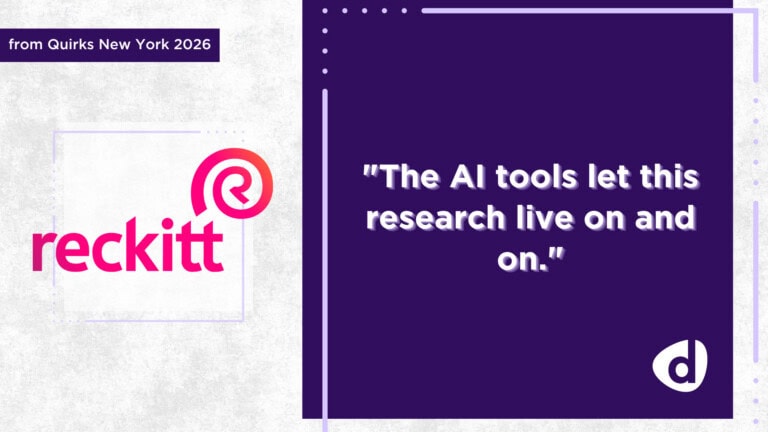
“The AI tools let this research live on and on.”
Allison Howitt, Global Insights & Analytics Director, Mead Johnson Nutrition, Reckitt
What she is driving with her team is a move off the question-to-question treadmill. Instead of answering one business question, then the next, then the next, she wants them gathering bigger data sets that can answer many questions at once. That is the shift: from answering one question at a time to building research the whole team can keep asking questions of.
What does “research that never sleeps” actually mean?
Two things, and they work together. First, AI-moderated interviews run while you sleep. An AI interviewer can talk to a healthcare professional at 9 pm on a Sunday, or run in parallel across time zones, without a moderator awake in every market. Second, the research you have already done stays alive. Every interview, every transcript, every clip becomes something anyone can query later, so the learning compounds instead of expiring.
Discuss is an always-on market insights solution. It brings live interviews, AI-moderated interviews, self-paced video, surveys, and past research from any source into one place a team can question directly. The payoff shows up on the next study, which starts with everything the last one already learned.
When should you use AI moderation instead of a human interviewer?
Lead with the audience and the topic, not the technology. AI and human moderation are two halves of one method, and the useful question is which half fits the moment. Allison’s team reaches for AI interviews when scale, access, or candor matter, and for live human sessions when depth and nuance do. Both run on the same platform, so the choice never means switching tools or losing continuity.
The candor finding is the one that surprises people. Mead Johnson Nutrition tested AI-moderated interviews against human-moderated ones directly.
“We’ve tested AI-moderated versus human-moderated, and the AI moderation gets more candid responses. The AI moderator is not judgmental.”
Allison Howitt
The reason is that there is no one to perform for. In categories where the subject is personal, sexual health being the obvious one, people soften the true answer in front of another human. An AI moderator asks the uncomfortable question without flinching, and people answer it. Allison had a practical version of the same point: have respondents talk, not type. When people type, they edit. When they speak, you get what is actually on the top of their mind.
We see the same pattern with our own customers. The team at HelloFresh, who described themselves as AI skeptics going in, were consistently struck by the quality of AI moderation once respondents started talking more freely without a moderator in the room. Forrester™ analysts found AI moderation was the one AI capability research buyers were uniformly excited about, because it opens up qualitative work at a scale humans alone cannot reach.
One thing AI moderation does not do is replace talking to real people. When a vendor pitched Allison on synthetic respondents, her answer was that if a study needs five interviews, her team can find five real people. Discuss builds AI on top of real human research, not instead of it. That is the line that matters: humans work with AI to make it more powerful.
How do you move a team from project-to-project to a research habit?
You remove the friction, then let a small win spread. Allison’s team at Mead Johnson Nutrition is deeply quantitative by instinct. Her words: if we don’t measure it, we don’t do it. Getting a quant-first team to build a qualitative habit took years of hearing no, until she changed what it cost them to say yes.
She bought one large block of platform time on a global basis, then told her teams they could use it without a PO, a statement of work, or an invoice. She handed them discussion guides and screeners already built. She made the reports easier by letting the platform draft the first version. Once the barrier was gone, a highly quantitative team in Canada tried consumer connects, a mid-level manager ran a few, and it spread. Within about six weeks it had become a weekly habit, and eventually the general manager was running them too.
The structural decision underneath the habit is the one worth copying:
“For the last four years, 100% of my qual is on the same platform. All of my video, all of my consumer connects, all of my transcripts. And now we can run large language models off of that.”
Allison Howitt
It does not require using a Discuss moderator. Her teams bring in whichever moderator they want, IQVIA, Ipsos, a sole-proprietor moderator, whoever fits the study, as long as the work lives on one platform. Allison remembers the alternative clearly: videotapes and discs stacked under her desk. That single rule is what turned four years of scattered projects into one queryable body of research.
What is Discuss Intelligence, and how does it turn research into a continuous asset?
Discuss Intelligence is the queryable workspace that sits on top of all of that research. We launched it at Quirks New York 2026. It turns every study an organization has run into one connected, always-on system anyone can question in plain language. It has two ways in.
The first is Ask Your Data, our Conversational Insights capability. You ask a question the way you would ask a colleague, and it searches across your entire body of research, not one project, and synthesizes an answer in seconds. Open-ended responses are coded automatically, so the answer comes back as themes, volume counts, and charts rather than a single paragraph. Every answer is traced to its source.
“It’s all traceable. You can see exactly where the response came from and hear the clip from the respondent who said it. It will not make things up. And if it doesn’t have an answer for you, it will let you know.”
Kirsten Nantz, SVP of Product, Discuss
That last part mattered most to Allison, and the reason is worth spelling out. Most AI tools will always give you an answer, whether or not they have the data to support one. Discuss Intelligence flags the gap instead, and points you toward the study that would fill it. A tool that guesses and a research partner that tells you what it does not know are two different things, and Allison knew which one her team needed.
The second way in is Ask Your Persona, our Virtual Personas capability, in beta. These are personas built from your organization’s own primary research, real respondents and real verbatims, not synthetic profiles invented from demographics. You can pressure-test a concept or a campaign direction against what your actual customers have already told you, before you commit budget to a new study. It is a smarter starting point for research, not a replacement for it.
Here is what that looks like in practice. A researcher on Allison’s team can ask for a reel of parents talking about the transition from breastfeeding for cow’s-milk-allergy babies, and the answer draws on years of accumulated interviews rather than one study. Discuss Intelligence also meets researchers where they already work. Through a standard connection (MCP), you can ask a question from the corporate AI tools your company already uses, like Copilot or Gemini, and get answers pulled from your own research library, with the analysis running underneath. And because it is built to package the output, a team can go from a question to a set of coded answers, quotes, and a shareable summary in minutes instead of days.
How is this different from asking ChatGPT or a research repository?
This is where teams get stuck. Most insights leaders are already stitching tools together. Allison described her team using one AI tool for social listening, another for quantitative data, Discuss for qualitative, and a general assistant like Copilot or ChatGPT on top of all of it. The tools are good. The problem is that they do not talk to each other, and the general ones do not know your research.
General-purpose LLMs like Claude, Copilot, and ChatGPT are strong at language, but they cannot query your organization’s research library, they have no coding methodology behind the numbers they produce, and they can fabricate a quote or a source. Research knowledge platforms like Stravito and Market Logic DeepSights organize research after it is finished, so you are querying summaries and finished reports, not the raw interviews and coded open-ends underneath.
Discuss Intelligence is the better choice for questioning your own research because it collects the primary research and queries it in one system. It returns quantifiable outputs from qualitative data, counts and percentages from coded open-ends, and it traces every answer back to the participant, the segment, the verbatim quote, and the video clip. That traceability is what makes an answer safe to act on.
Real customers already work this way. Mondelēz has run 337 projects and 1,254 sessions across more than 29 markets over a decade on Discuss, and a stakeholder’s morning question now gets answered by end of day from research already collected, with no new study commissioned. HelloFresh went from a 24-hour research cycle to, in their words, 24 seconds, by asking questions of accumulated study data instead of starting over.
What does always-on research change for insights teams?
It changes what the team spends its time on. When the tactical questions get answered in seconds from research you already own, the researchers stop being the bottleneck and start being the strategists. Allison said it better than I could.
“The less time we can be historians and librarians and more time actually being business partners makes all of us happy.”
Allison Howitt
That is the real payoff of research that never sleeps. Forrester™ data points in the same direction: 52% of design and research professionals now use centralized insights to train internal AI tools, which is another way of saying the research repository is becoming an organization’s queryable memory. The teams that build that memory now, on one platform, will be the ones answering the hardest questions fastest a year from now.
Discuss is a Forrester™ Wave Leader for Experience Research Platforms, Q1 2026, one of only two vendors named a Leader, with the highest possible score in 15 evaluation criteria. We earned that by building AI and human research, qualitative and quantitative, into one system, so a team never has to choose which half of the method to give up.
If you want to see what asking your own research anything looks like, come find the Discuss team or reach out for a walkthrough of Discuss Intelligence.
Frequently asked questions
What is AI-moderated research? AI-moderated research uses an AI interviewer to conduct interviews, probe on each answer, and analyze responses, without a human moderator in the session. On Discuss it runs in more than 50 languages, around the clock, and captures video, audio, and transcripts. Teams use it when scale, around-the-clock access, or respondent candor matter, and use live human moderation when depth and nuance matter more.
Does AI moderation get better or worse answers than a human interviewer? It depends on the topic. Reckitt’s Mead Johnson Nutrition team tested AI-moderated interviews against human-moderated ones and found AI moderation produced more candid responses on sensitive subjects, because respondents felt less judged. For exploratory or emotionally complex work, human moderation still offers depth an AI session cannot match.
What is Discuss Intelligence? Discuss Intelligence is an always-on, queryable workspace that turns every study an organization has run into a connected system anyone can question in plain language. It has two capabilities: Ask Your Data (Conversational Insights), which answers questions across your full research library with source-traced, quantifiable results, and Ask Your Persona (Virtual Personas), which builds personas from your own primary research to pressure-test ideas.
How is Discuss Intelligence different from asking ChatGPT? General-purpose tools like ChatGPT, Claude, and Copilot cannot query your organization’s research library, have no coding methodology behind their numbers, and can fabricate quotes. Discuss Intelligence queries your own primary research, codes qualitative responses into counts and percentages, and traces every answer to the participant, quote, and clip it came from.
How do you stop research from being wasted after one project? Keep all of it on one platform so it stays queryable, and use a tool that can search across every study rather than one report at a time. Reckitt’s nutrition team kept 100% of its qualitative research on one platform for four years, which is what let its accumulated research become an asset the whole team can reuse.
Ready to unlock human-centric market insights?
Related Articles
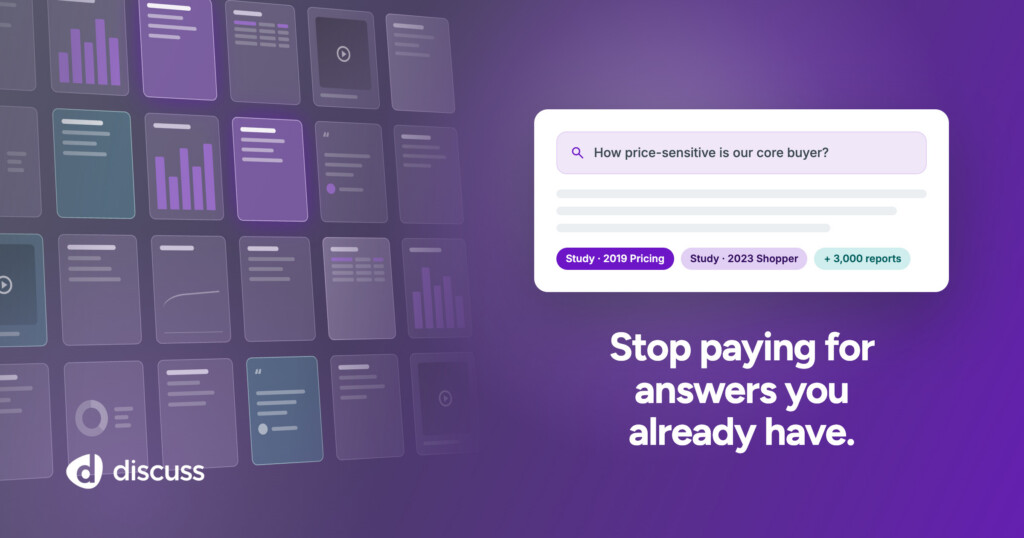
How to Operationalize the Insights Librarian Role and Stop Insights Slop
By Daniel Graff-Radford, CEO, Discuss Last updated: July 2026 Summary: Most organizations waste millions of dollars researching questions they already…
By Daniel Graff-Radford, CEO, Discuss Last updated: July 2026 Summary: Most organizations waste millions of dollars researching questions they already…
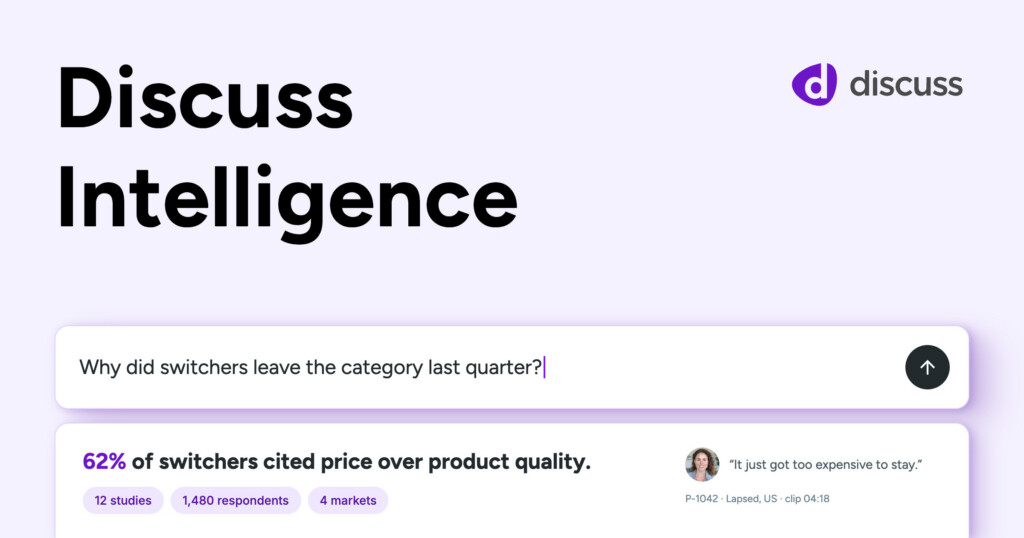
What Is Discuss Intelligence? How Discuss Turns Your Entire Research Library Into an Always-On Intelligence Layer
By Kirsten Nantz, SVP of Product, Discuss Last updated: July 2026 Discuss Intelligence is Discuss’s AI-powered research intelligence capability. Ask…
By Kirsten Nantz, SVP of Product, Discuss Last updated: July 2026 Discuss Intelligence is Discuss’s AI-powered research intelligence capability. Ask…

How to Evaluate AI Research Tools and Prove Their ROI: What Insights Teams Get Wrong
By Cayleigh McCarthy, VP of Global Customer Success, Discuss Published June 2026 Key takeaways: At IIEX North America in April…
By Cayleigh McCarthy, VP of Global Customer Success, Discuss Published June 2026 Key takeaways: At IIEX North America in April…