


Predictive Agentic AI for Campaign Testing: Forecasting Success Before Launch

Imagine being able to predict how your next marketing campaign will perform—before you spend a dollar on media. That’s the power of predictive agentic AI.
By blending intelligent data models with real-time consumer insight, agentic AI platforms are giving marketing teams the ability to forecast campaign performance, optimize creative strategies, and avoid costly misfires long before launch day.
In this post, we’ll break down what predictive agentic AI is, how it works, and why it’s quickly becoming a must-have tool for agencies and brand marketers.
What Is Predictive Agentic AI?
Let’s start with the basics.
An agentic AI is an intelligent, semi-autonomous software system that doesn’t just follow commands—it perceives, learns, and acts toward a goal.
When applied to campaign testing, predictive agentic AI acts as both analyst and strategist. It can:
- Run AI interviews and collect qualitative feedback at scale.
- Detect consumer sentiment and emotional triggers.
- Model outcomes based on real-time responses.
- Recommend next steps to improve campaign performance.
These systems turn testing into a dynamic loop of insight and action—bridging the gap between creative inspiration and data-driven precision.
Why Campaign Testing Needs AI Agents
Traditional campaign testing is often too slow and too limited. By the time results come back, the window to act has closed. That’s where agentic AI comes in.
AI-powered market research tools like those on Discuss.io’s platform enable teams to:
- Gather insights instantly: AI interview agents can test multiple creative concepts or taglines in parallel.
- Interpret results automatically: Machine learning detects which messages resonate most strongly with your target audience.
- Predict performance: AI models simulate market reactions before your campaign ever goes live.
This isn’t just research—it’s preemptive marketing intelligence.
From Reaction to Prediction
The shift from descriptive to predictive insights is the real game-changer.
Descriptive insights tell you what happened.
Predictive insights tell you what’s likely to happen next.
Agentic AI agents analyze historical data, real-time interviews, and participant emotion to model probable outcomes. That means you can test not only how consumers feel about your message—but also how those feelings will influence behavior.
For example:
- Will humor increase engagement?
- Will a specific headline improve click-through rates?
- How will a new product message perform with Gen Z versus millennials?
Predictive agentic AI answers these questions with data-driven confidence.
Real-World Use Cases for Marketing Teams
Let’s look at how brands and agencies are putting predictive agentic AI into action:
- Creative Optimization
Instead of testing one ad at a time, AI agents can compare dozens of versions, identifying which combinations of imagery, tone, and messaging drive the strongest emotional response. - Market Segmentation Analysis
Predictive AI can highlight differences in how various demographic segments respond to creative elements—helping teams fine-tune their campaigns for maximum impact. - Pre-Launch Forecasting
Before spending on media, agentic AI runs simulations using real participant data to forecast performance metrics such as engagement, recall, or purchase intent.
You can see examples of how companies are leveraging AI-powered insights in Discuss.io’s case studies.
Benefits of Predictive Agentic AI
1. Reduce Risk
Make data-backed creative decisions before launch, reducing the chance of underperforming campaigns.
2. Save Time and Budget
AI automates much of the data collection and analysis, freeing teams to focus on strategy and storytelling.
3. Increase Confidence in Creative Choices
Predictive testing ensures the message you launch is the one most likely to resonate with your audience.
4. Continuous Learning
Every campaign teaches the AI model more about your audience, improving predictions for future efforts.
How to Integrate Predictive AI into Your Workflow
You don’t need to overhaul your entire research process. Instead, consider these steps:
- Start Small – Begin with a single campaign or concept test to evaluate the model’s accuracy.
- Train Your Agent – Feed your AI system with relevant brand, category, and performance data to sharpen its predictions.
- Combine Qualitative and Quantitative Inputs – Merge AI interview agent data with numerical metrics to create richer forecasts.
- Validate and Iterate – Use early learnings to refine campaigns continuously rather than waiting for post-launch analysis.
The Technology Behind Predictive Agentic AI
So what’s actually happening behind the scenes when predictive agentic AI “thinks”? It’s not just one technology—it’s an ecosystem of advanced tools working in sync to mimic human reasoning and continuously get smarter over time.
Here’s how the key components fit together:
- Natural Language Processing (NLP): This is the AI’s language decoder. NLP helps systems understand not just what someone says, but how they say it—the tone, emotion, and intent behind their words. For market researchers, that means the AI can detect whether a response is enthusiastic, hesitant, or skeptical, just like a skilled human moderator would.
- Machine Learning (ML): Think of ML as the AI’s pattern-spotting engine. It takes in thousands of data points—responses, behaviors, outcomes—and finds the common threads. Over time, it begins to predict how certain audiences might respond to similar stimuli. The more it learns, the more accurate and efficient it becomes.
- Knowledge-Based Agents: These add the “brains” of subject-matter expertise. Unlike general-purpose AI, knowledge-based agents are trained on specific domains—such as consumer research, healthcare, or finance—so they can interpret responses in context. For example, they understand that “ROI” means something very different to a marketer than to a healthcare professional.
- Autonomous Agents: These are the self-directed workers in the system. Once trained, they can run continuously—gathering data, testing hypotheses, and refining their own models without constant human input. That means predictive agentic AI doesn’t just automate tasks—it actually evolves.
Together, these technologies make predictive agentic AI adaptive, not static. Every interview, every response, every new dataset becomes fuel for improvement. The AI learns from both machine signals and human feedback, adjusting how it interprets and predicts over time. The result? Smarter, faster, more context-aware insights that evolve in real time—helping teams move from understanding the past to anticipating the future.
AI as the Creative Partner
Predictive agentic AI isn’t here to replace creative professionals—it’s here to collaborate with them. Think of it as a creative co-pilot that provides instant feedback, evidence, and direction.
As AI models grow more sophisticated, marketers will be able to:
- Simulate different market scenarios.
- Predict emotional resonance with precision.
- Adjust campaigns dynamically even after launch.
This evolution turns marketing from a guessing game into a continuous feedback system—one where insight and creativity fuel each other.
Blending Human Creativity with Machine Precision
Predictive agentic AI is redefining how marketing teams test and launch campaigns. By blending human creativity with machine precision, it allows brands to forecast success instead of reacting to failure.
If your agency or brand is ready to move from reactive to proactive, now’s the time to explore predictive AI tools.
Discover how Discuss.io’s AI-powered research platform can help you forecast outcomes, refine messaging, and accelerate success.
Request a consultation today and see the future of campaign testing unfold in real time.
Ready to unlock human-centric market insights?
Related Articles
The New Research Contract
Executive Point of View — 2026 How Marketing and Insights can move faster without growing further apart A point of…
Executive Point of View — 2026 How Marketing and Insights can move faster without growing further apart A point of…

From Resolution to Reality: How Human-Led AI Research Shapes Smarter 2026 Growth Strategies
Every January Starts With the Same Question: “Are We Doing This Right?” January has a particular energy inside organizations. New…
Every January Starts With the Same Question: “Are We Doing This Right?” January has a particular energy inside organizations. New…
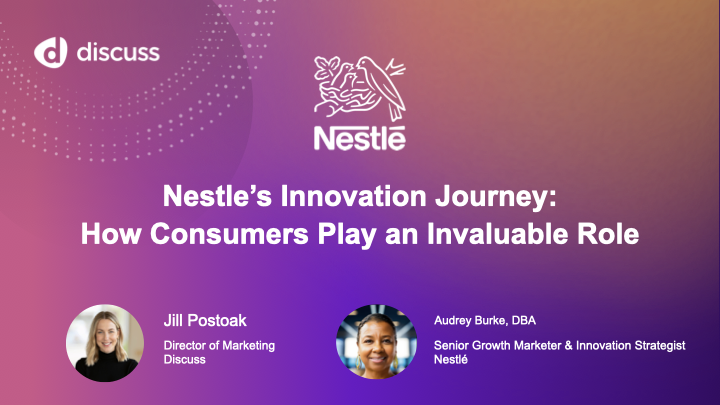
Nestlé’s Accelerator Shows What Happens When the Whole Company Listens
By Jill Postoak, Director of Marketing, Discuss When I joined Nestlé’s Audrey Burke on stage recently at the Insights Association’s…
By Jill Postoak, Director of Marketing, Discuss When I joined Nestlé’s Audrey Burke on stage recently at the Insights Association’s…