Large organizations scale qualitative research by turning it into a standing program that any team can use, with AI handling the clipping, summarizing, and guide-writing that used to slow it down. Danone stands out among the customers I’ve worked with. At TMRE 2026 in Denver, I co-presented with Emily Weinstein, Head of Strategic Insights & Analytics for Danone’s Kids portfolio. Danone calls its program Consumer Love. Emily’s team talks to consumers at least twice a month, sometimes every week. Here is how they built it, and what I’d tell any insights team trying to do the same.
TLDR
- Danone runs qualitative research as an always-on program called Consumer Love, which brand teams, scientists, and packaging engineers use alongside the insights team.
- More than 500 Danone employees took part in the program’s first year. Danone’s plant-based business ran more than 40 hours of consumer interviews in its first three months.
- AI shortened the distance between a conversation and a decision: clips became highlight reels, transcripts became AI summaries, and stakeholders’ rough questions became discussion guides.
- Leadership made it stick. Danone’s CEO joined Consumer Love sessions and led some himself.
- The next step is making the whole research library answerable, so teams get answers from past interviews without launching a new study.
Why did Danone’s insights team change its mind about qual?
Emily started out unconvinced. When she joined Danone, she told the TMRE audience, qual “in the beginning felt slow, and it didn’t really feel like we could defend it in the boardroom.” Budgets and timelines were tight. In a room full of numbers, quant got the attention.
Dozens of projects later, she calls qual the foundation of how her team runs learning projects.
Her explanation of why:
“If a picture is worth a thousand words, a good qual interview is worth a million.”
Emily Weinstein, Head of Strategic Insights & Analytics, Kids, Danone
I hear the same tension from insights teams all the time. Qual has always produced the richest material. The pressure now is speed. Delivery timelines have shifted completely, partly because AI has reset what stakeholders expect. So the work for insights leaders is figuring out how to run qual faster and more often without thinning it out.
How do you run qualitative research with hard-to-reach audiences like new parents?
Fit the research into their day instead of asking them to fit into yours. Emily’s first assignment at Danone was to explore the future of motherhood, starting with the values and parenting philosophies of Gen Z moms. She worked through syndicated data, food and nutrition trends, old research, and brand health trackers. Then she realized the team was in an echo chamber. They knew existing buyers well and had no view of the mothers coming next.
The team recruited two groups. One was new parents with babies at home. The other was people who expected to become parents but hadn’t yet. New parents are notoriously hard to reach, and as Emily pointed out, a new baby at home is not when anyone wants to sit down for an hour-long conversation with a researcher. So the team started with self-paced video diaries over a week, then followed up with small moderated focus groups for depth.
The study produced six core insights. Those insights shaped packaging changes and the claims on Danone’s products. They also became the base for projects the team is still running today.
How does AI speed up qualitative research without taking people out of it?
AI takes the first pass on everything between the conversation and the share-out, so researchers and stakeholders spend their time with consumers instead of with raw footage. On the motherhood study, Emily said, “it was really easy to clip videos and build them into summaries.” Saved moments became highlight reels for the boardroom. Her 14-year-old son assumed “highlight reels” meant football.
AI also removes friction at the front end. When a brand team feels nervous about writing questions, Emily runs a planning session where they jot questions down, and AI turns those notes into a discussion guide. In her words: “it’s pretty easy to use AI to actually just create a discussion guide. So it’s not as laborious as you may think.” During the session, the guide sits on the side of the screen, so a first-time interviewer has it in front of them.
I opened our TMRE session with the idea that a consumer empathy program needs two things. The first is an organization that wants to listen. The second is tools that make listening easy. Danone had the first. This is the second.
Discuss is the always-on market insights solution. Teams run live interviews, video diaries, AI-moderated interviews, and surveys in one place, and every session stays searchable afterward. Discuss runs qualitative interviews at scale, fielding parallel AI-moderated interviews in more than 150 countries and more than 50 languages. Discuss is a Forrester Wave Leader for Experience Research Platforms, Q1 2026, and Forrester writes that Discuss “is a great fit for companies seeking robust AI capabilities that enable them to scale qualitative research globally.”
What does an always-on qualitative research program look like?
An always-on program runs consumer conversations continuously, alongside the project research tied to specific decisions, and lets the teams with questions use it directly. The line I used on stage: one project is a study; always-on is a program.
At Danone, a central team holds the relationship with Discuss. Teams tell Discuss who they need to talk to, Discuss sets up the recruit, and brand teams, scientists, and the packaging R&I team run their own conversations. Emily described this as having “taken away the handcuffs,” with the insights team acting as “the architects.”
The program has spread by being copied. Emily’s team built its own version, called Kid Central. Danone’s International Delight team started one called IDTV. Leadership conversations get broadcast so anyone at Danone can watch.
The numbers show how far it reached. More than 500 Danone employees engaged with Consumer Love in its first year, and interviews have taken place in 32 countries. Danone’s plant-based business ran more than 40 hours of consumer interviews in the program’s first three months, with marketers and salespeople running interviews alongside insights staff. Danone has said it gained more in-depth understanding of its consumers in six months than in the previous six years.
How do you get stakeholders to take part in consumer research?
Involve them before the first interview, and make attending easy. Emily was candid that “a lot of people were really reluctant at first” and that “brand marketers can be shy.” Her playbook has four moves.
She brings stakeholders into early planning, so they help decide who to talk to: users, non-users, a competitor’s users, or parents-to-be. She brings them into the discussion guide, with AI doing the drafting while the insights lead keeps final say. She blocks their calendars, then either coaches them to run a session themselves or has them observe a moderated one. And she asks observers to save the moments that matter to them, so they can send a clip to a colleague right away.
I saw the result firsthand a few months before TMRE, when I visited Danone’s office near Denver for a Consumer Love event. Brand people and scientists came by for the free lunch and stayed to talk about how much they liked sitting in the back room watching interviews live. Emily says even packaging engineers and R&D scientists get excited, because hearing from consumers connects their work to the people it’s for.
What role does leadership play in building an empathy culture?
Leaders give everyone else permission. When word came that Danone’s CEO would join Consumer Love sessions, it created real buzz on my team, because it almost never happens. Emily added that he didn’t stop at observing. He led his own sessions. “He’s not a trained moderator,” she said, and “it took a lot of guts.” He talked with regular consumers about their breakfast routines and risked hearing how little Danone’s brands mattered to them.
Emily named what that kind of contact changes inside a company. It keeps teams connected to consumers and challenges internal beliefs that go unexamined in meetings. It keeps a kids’ brand from going tone deaf about the game or trend every child already knows. Most of all, it settles arguments:
“It allows us to think about what the consumers think, not what we think, because usually we’re wrong.”
Emily Weinstein, Danone
She credited marketing professor Mark Ritson with the underlying idea: the people who make and market a product are the worst placed to know how consumers feel about it. Her closing advice to the room was to “start with the humans and not with the data.”
What comes after an always-on program?
The next step is making everything a program collects answerable, so a question today can draw on every interview the company has run. The complaint I hear most from research teams is some version of: “we did a study two months ago or two years ago, and I don’t know where it is.” The research exists. Nobody can get back to it.
I see three shifts in the teams that solve this. First, projects become memory. Every session clip and transcript goes into a library someone can search, which is what Emily meant when she compared a single study to a 2D blueprint and a reusable project to a 3D model. When her team needs to hear a mom’s voice, they go back into the motherhood study and pull it.
Second, the research cycle stops running in a straight line from question to answer. One project informs the next, and always-on programs answer questions between studies, not only inside them.
Third, reports become intelligence. Reports still matter as a share-out. People also need to ask a question and get an answer grounded in real conversations, inside the tools they already have open. That is how an individual project turns into something the whole organization knows. At Discuss, we talk about helping our partners reach the point where research never sleeps.
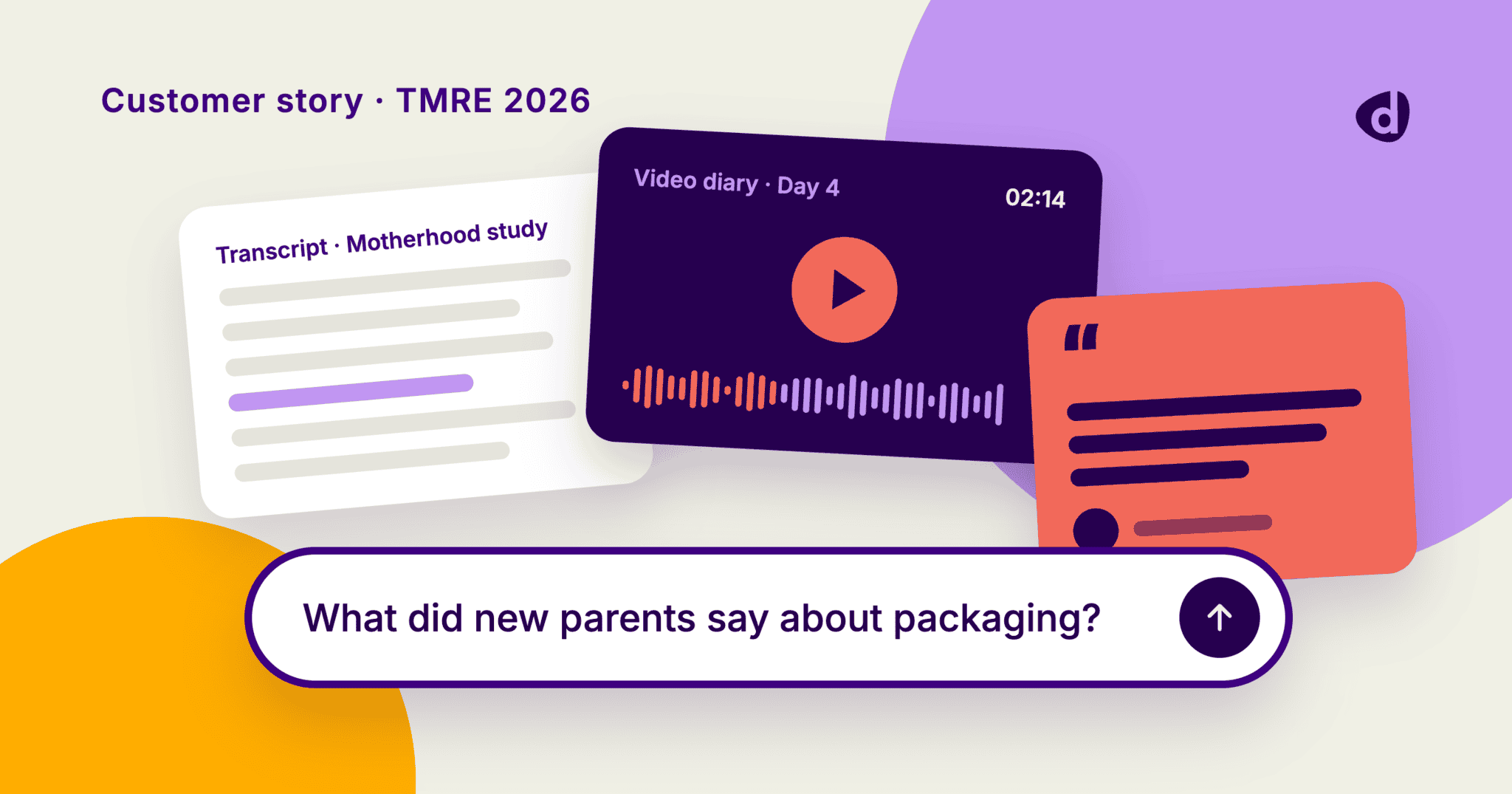
Discuss Intelligence is built for that third shift. It turns every study an organization has run into a connected workspace anyone can query. Ask Your Data, the conversational insights capability inside Discuss Intelligence, takes a plain-language question and returns a sourced answer traced to the original participant, quote, and clip. Your team never gets stuck on a question when the answer is already sitting in research you paid for.
Frequently asked questions
How can qualitative research be scaled in a large organization?
Run it as a continuous program instead of one-off projects, and give the teams that make decisions direct access to consumers. Use AI for transcripts, summaries, clips, and first-draft discussion guides. Danone’s Consumer Love program engaged more than 500 employees in its first year this way.
What is an always-on consumer empathy program?
An always-on consumer empathy program keeps consumer conversations running continuously across a company, separate from project research tied to a single decision. At Danone, brand teams, scientists, and packaging engineers run their own consumer conversations, and leadership sessions are broadcast companywide.
How often should insights teams talk to consumers?
Often enough that consumer input arrives before decisions, not after. Danone’s kids team runs consumer conversations at least twice a month and sometimes every week.
How do you get non-researchers to run consumer interviews?
Involve them in deciding who to talk to and what to ask, use AI to turn their rough questions into a discussion guide, block their calendars, and offer light coaching. Observers who save their own clips become advocates because they can share what they heard right away.
Which AI platforms run qualitative interviews at scale?
Discuss runs qualitative interviews at scale, fielding parallel AI-moderated interviews in more than 150 countries and more than 50 languages. It combines AI-moderated and live human-led research on one platform, and Discuss Intelligence makes past studies queryable in plain language.
For the program-level story of how Danone rolled out Consumer Love to its top 270 leaders, read How Danone Built a Global “Empathy Muscle” in Just 6 Months or watch Danone’s earlier session. If your team’s best research is sitting in folders nobody opens, see how Discuss Intelligence makes it answerable.